
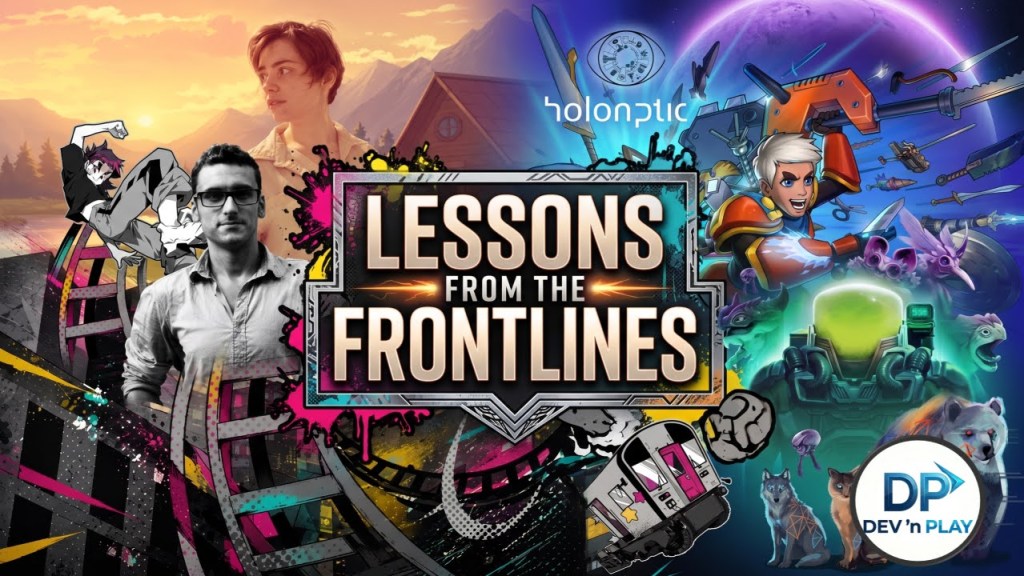
The past two weeks have been incredibly busy for us, and we’ve had the privilege of sitting down with developers from all corners of the games industry. From solo creators working on their first title to experienced teams with ambitious new projects, every conversation offered a different perspective on what it takes to make games.
One thing quickly became clear: while every developer has their own approach, they all shared valuable lessons about creativity, overcoming challenges, and bringing ideas to life. We wanted to gather those conversations in one place, so whether you missed an interview or simply want a quick recap, you’ve come to the right place.
1. The Reality of the Indie Leap: Temple Door Games (Swordcery)
Swordcery is an upcoming hack-and-slash roguelite ARPG launching in Early Access on August 11th. Behind this wonderfully chaotic world of Armorial is Temple Door Games, a two-man indie studio based in Los Angeles. But founders Mike Henriet and Don Thurakichprempri aren’t your average indie newcomers; they were part of the elite cinematic animation team that brought Sony Santa Monica’s 2018 masterpiece, God of War, to life.

For other AAA developers sitting on a comfortable salary and dreaming of making the leap over a shared burrito, Temple Door Games offers a sobering, yet essential piece of advice:
“Making an indie game is hard! We went in thinking this would be incredibly difficult and STILL have been floored by how devastating challenging it all is. Hands down, we both agree this is the hardest thing we’ve ever done. For any AAA developer thinking about transitioning to indie, we would advise they really consider all the hats you have to wear as an indie developer. You may be a capable animator but are you going to be able to model, rig, texture, community manage, market, design sound, program complex systems etc. The list goes on! And more importantly, do you think you can enjoy doing all of that? It’s kind of one of those things you can never truly understand the weight of until you’ve been burdened by it no matter how much warning you receive though! If we had to say just one thing anyone could understand it would be: Marketing is MUCH more of a timesink that you could ever imagine and doing so successfully is incredibly difficult on top of actually making your game.”
2. Taming Feature Creep as a Solo Dev: Glazial (Holonoptic)
For the past six years, Kevin Bloch has been building Holonoptic almost entirely on his own. Developed under the studio name Glazial, the game combines an unusually detailed economic simulation—complete with supply chains and more than 50 companies—with a narrative-driven RPG set in an alpine cyberpunk world. Bloch handled the design, programming, writing, and artwork himself, while composer Annina Suter created the soundtrack and a small voice cast brought the characters to life.

After six years of solo development, Bloch’s advice for other developers centers on resisting the urge to implement every new idea immediately:
“The first trick that worked for me is to use a backlog. I have a backlog that is full of ‘brilliant’ ideas that luckily never made it into the game. As a solo developer, nobody is there to stop you, so the temptation to immediately try out or implement whatever comes to your mind is always there. Instead, if you have an idea, let it swim around in your backlog for a while. Does it still sound like a good idea a few weeks later, does it fit with the mechanics and world? Then decide whether it should be in the demo, the release, or some later patch.”
He also found motivation in thinking beyond the current project:
“The second trick might sound a bit contradictory, but what helped me was to dream of my next project. The only way to start working on it was to bring the current one over the finish line. This created the required focus to polish holonoptic, with the distracting creative energies contained in a notebook (‘my next project’) rather than producing more feature creep.”
3. Knowing When to Draw the Line: Hatchery Games (Voidling Bound)
The folks at Hatchery Games are trying something really fun with Voidling Bound, mixing fast-paced, third-person shooting with a deep system where you breed and customize your creatures.

To see how this all came together, we talked to Frederick Gagnon, Cofounder and Executive Producer at Hatchery Games. We asked Frédérick how they knew when to draw the line during development, and what advice he has for new developers trying to keep their game’s scope under control.
“That is a very tough one because even though we held back, we actually produced features way past the moment where we wanted to freeze the first time. We tried to keep playtesting as late as possible with our community and we felt that our pipeline was organic enough that we could add stuff pretty late.”
He also added that:
“If I had to give an advice, I’d say get feedback as early as possible from your community and from your core audience. Don’t lose yourself developing too many features while your core gameplay loop is still shaky, or doesn’t respond well with your players. You need your most simple version of the game to be solid and fun, and from there start your roadmap to scope up your game!”
4. Prototyping the Impossible: (Denshattack!)
Denshattack! takes the fluidity and combo-chasing loop of classic extreme sports titles and applies it directly to… high-speed trains. It’s a premise that immediately raises massive technical red flags. Game director David Jaumandreu and his team at Undercoders had to figure out how to make a rigid, linear, and massive vehicle express the dynamic flair of a skater without completely breaking the game engine.

When we asked how they tackled such a wild concept without getting overwhelmed, David emphasized the importance of trusting the players:
“To make a lot of playtests with real players, observe how they play and iterate the character controller until it’s intuitive to use. This was essential for us to understand what was working and fun in our gameplay and what was too overwhelming or frustrating. When we finally were comfortable with our moveset, gameplay and game feel, we could map out a full scope of Denshattack! that was realistic, potentially engaging and feasible to produce.”
5. Blending Combat and Narrative: (Oops! You’re the Hero!)
Oops! You’re the Hero! is a story-centered, top-down fantasy adventure where you play a down-on-his-luck Thief. If you’ve played the demo, you know this particular hero steals a powerful artifact, instantly regrets the trouble it brings, and journeys across the land just to get rid of it.

We recently sat down with developer Kit Arnold at Artificium Games to dig into this delightfully reluctant premise. We wanted to know how she managed to balance the game’s action with its heavy narrative focus without letting the two elements clash:
“When it comes to not clashing, look at the games you loved to play! How they mix combat and story, what’s going on in the environment at the moment, what is catching your eyes before you swap from one state to another are all things to keep in mind when trying to match the same smooth feeling you want to be inspired by. Having a general outline of what you want placed where, and whether or not you value combat vs narrative (or vice versa), generally helps to guide what needs to be placed where and how the player should respond to their environment.
She also added something equally important:
“It’s going to sound strange, but if you find a spot that feels clunky or doesn’t seem like it’s working – talk to your characters! Get to know them and understand who they are. That’s what helped me figure out when things felt good to add or not. You’re telling a story in a way that involves not just the player, but the character(s) they’re hanging out with. There were many times I had to sit back as both the dev and a player, look at the Thief and Tut, and go, “What are we doing here?”. Sometimes that answer was a clever quip, or a fight that needed to take place. And it didn’t go for just them. The other characters in the story have their own lives and goals, and that can be explored too to affect the player’s actions and how they respond to what’s coming after them. Overall, let your characters live and breathe like you do.“
Huge thanks to all the PR agencies that helped us make these interviews possible!

Leave a comment