
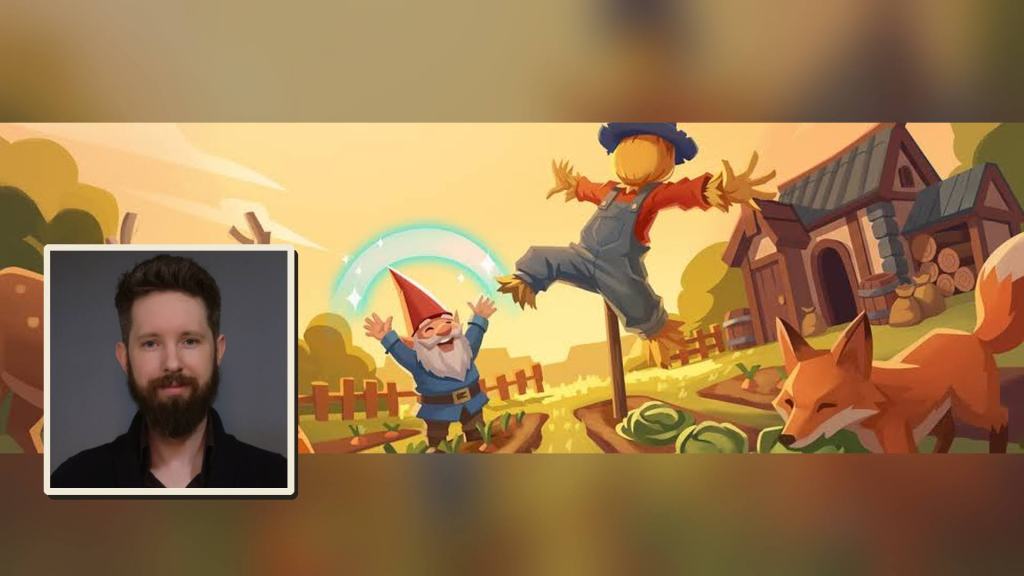
PineFog Studios’ upcoming game, Tattie Bogle, puts us in charge of protecting a farm from hungry pests and supernatural creatures while managing crops, crafting equipment, and building defenses. This unusual mix of farming simulation, tower defense, and roguelite action seems neatly wrapped up in a charming folklore-inspired setting. We had the opportunity to speak with Andrew Johnson, founder of PineFog Studios, about the ideas behind the game, the challenges of bringing so many mechanics together, and some amusing discoveries made during development.
This interview would not have been possible without the wonderful people at Plan of Attack. Many thanks Sergey Khoroshykh!
A Scarecrow With a Shopping List
One of the funniest ideas in Tattie Bogle concerns the relationship between the scarecrow and the farmer. Our character has been brought to life through magic, but the poor farmer is completely unaware of this little development. The devs have found a clever way around the problem, allowing us to influence the farmer’s purchases without revealing our secret. We were curious why Andrew chose this particular approach and whether it caused any trouble during testing.
The game is about a scarecrow that’s been brought to life by a Tomte. It’s a bit like Toy Story: the toys are alive, but they act like ordinary toys whenever a human is around. Here, the farmer has no idea the scarecrow can think. So instead of shopping directly, the scarecrow leaves a note on the farmer’s door, pretending to be a neighboring farmer offering advice. That’s how it influences what the farmer actually buys when he heads to market in town.
As for balancing, there have been a million things. For odd behavior, my favorite was when we found you could flip pests into the house with the pitchfork, and they’d just disappear into the void. Beyond that, finding the balance between action and tower defense, so you have both offensive and defensive strengths, is a constant back and forth.
We rather like the idea of a farmer unknowingly taking advice from his own scarecrow, although the disappearing pests sound like an equally entertaining discovery. The shopping arrangement also introduces a financial problem that players will need to consider throughout their adventure. Somebody has to pay for all those useful tools and upgrades.
The Cost of Keeping a Farm Alive
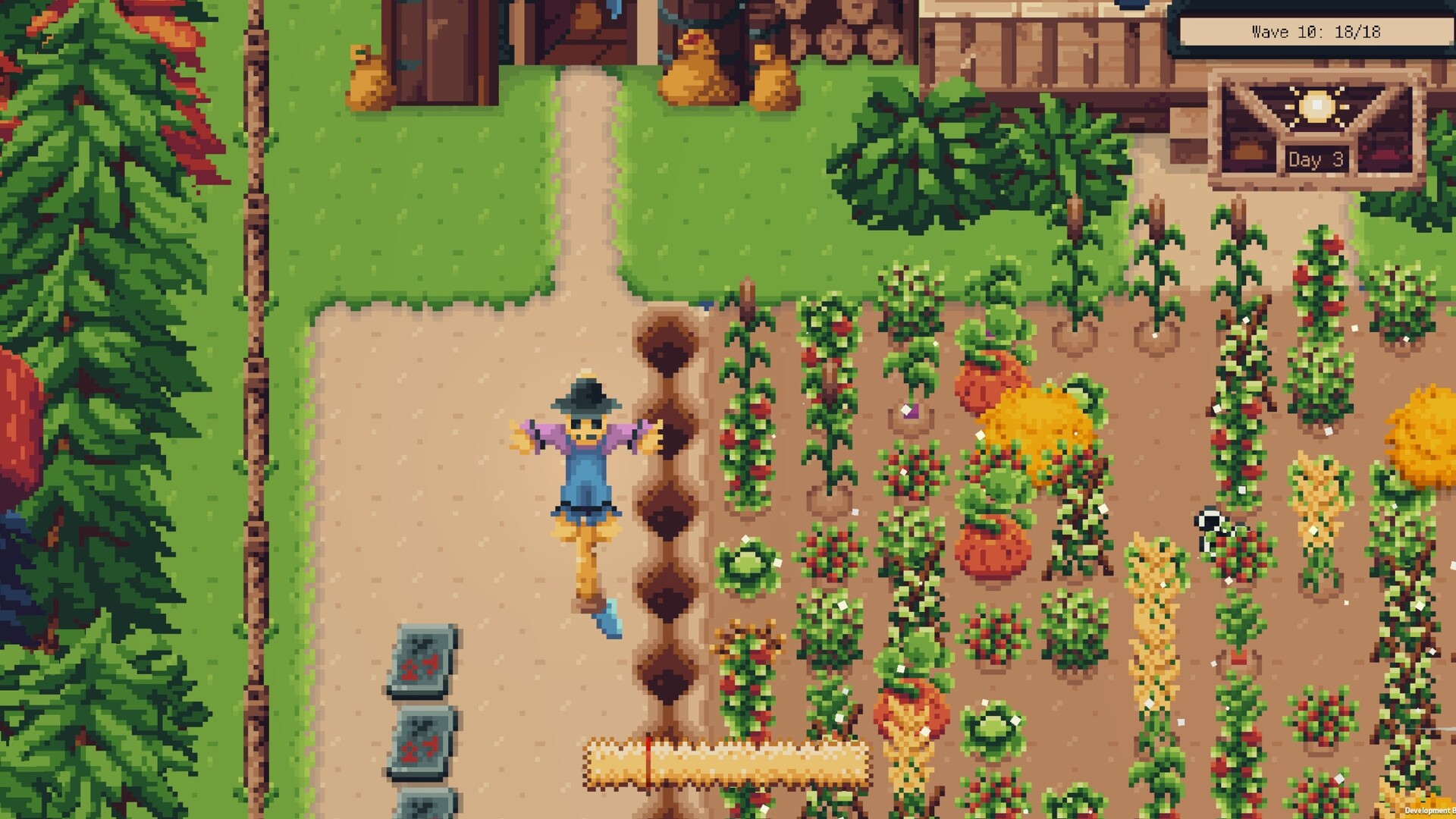
Although we’re responsible for protecting the harvest, we’re also allowed to collect crops for our own crafting needs. The problem is that anything we take from the field can no longer be sold by the farmer, leaving him with less money to spend at the market. We can imagine players getting carried away with gathering resources, only to discover that their enthusiasm has left the farm dangerously close to bankruptcy. Finding a reasonable balance between crafting supplies and farm income must have required plenty of adjustments, particularly during the opening hours when players have yet to unlock permanent upgrades.
When you first start the game, with no permanent upgrades, you do pretty much go nearly bankrupt right away, even if you barely take any crops from the field yourself. As you unlock more permanent upgrades, that burden eases. Depending on your play style, you can then lean one way or another: spamming crafting, improving your character, or leaving enough in the field for decent shop purchases. There was definitely a time when the shop was too expensive, and a time when it was too cheap, but it feels fairly weighted right now.
It sounds like our first few attempts at running the farm might be financially disastrous, regardless of how carefully we manage the harvest. Fortunately, permanent upgrades should eventually ease the burden and allow different approaches to managing resources. Players who enjoy crafting can concentrate on collecting materials, while those who prefer purchasing equipment can leave more crops for the farmer. Either way, we’ll need enough resources to defend the place, because the local wildlife has no intention of leaving our vegetables alone.
No Time to Stand Around Planning
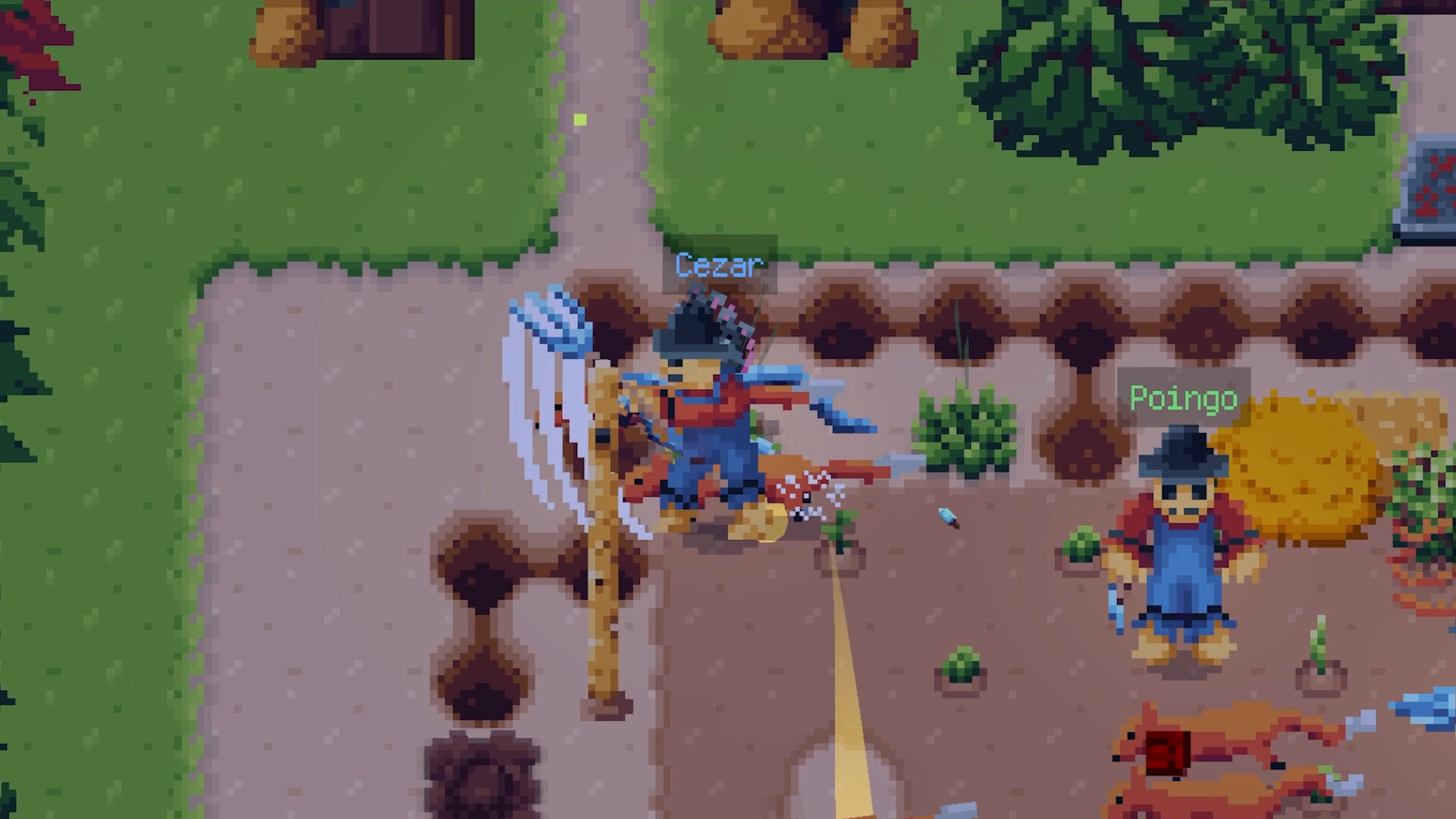
Anyone familiar with tower defense games knows how important preparation can be. We usually get an opportunity to examine the battlefield, decide where to place our defenses, and prepare for the next wave. Tattie Bogle isn’t quite so generous. Digging trenches, planting lures, and dealing with invading pests all happen in real time, meaning we might find ourselves desperately trying to finish a defensive structure while enemies are already tearing through the crops. Such an approach can certainly make encounters more exciting, although we wondered how newcomers reacted to having so many responsibilities at once.
That came up a lot, especially with new players. The feedback was that it felt too chaotic and they wanted more time to think. Believe it or not, we only recently added pausing in single player when you open the journal, and that takes off a lot of the real-time pressure.
One of the goals was to treat the game more like a sandbox, without a turn-based feel. The daily cycles already give the gameplay a natural progression and cadence. I wasn’t after a pure strategy game with perfect placement. I wanted to encourage split-second decisions in the moment too. As for map readability, the field gets much easier to read once you’ve put some time in and start recognizing patterns and familiar items.
The addition of a pause function sounds particularly useful for players who prefer taking their time with defensive planning. It also shows how feedback has helped Andrew adjust the experience while keeping the frantic nature of the combat intact. There’s plenty to manage already, and the situation becomes considerably more dangerous once we start digging up mysterious objects that were probably buried for a very good reason.
When Skeletons Become a Little Too Enthusiastic
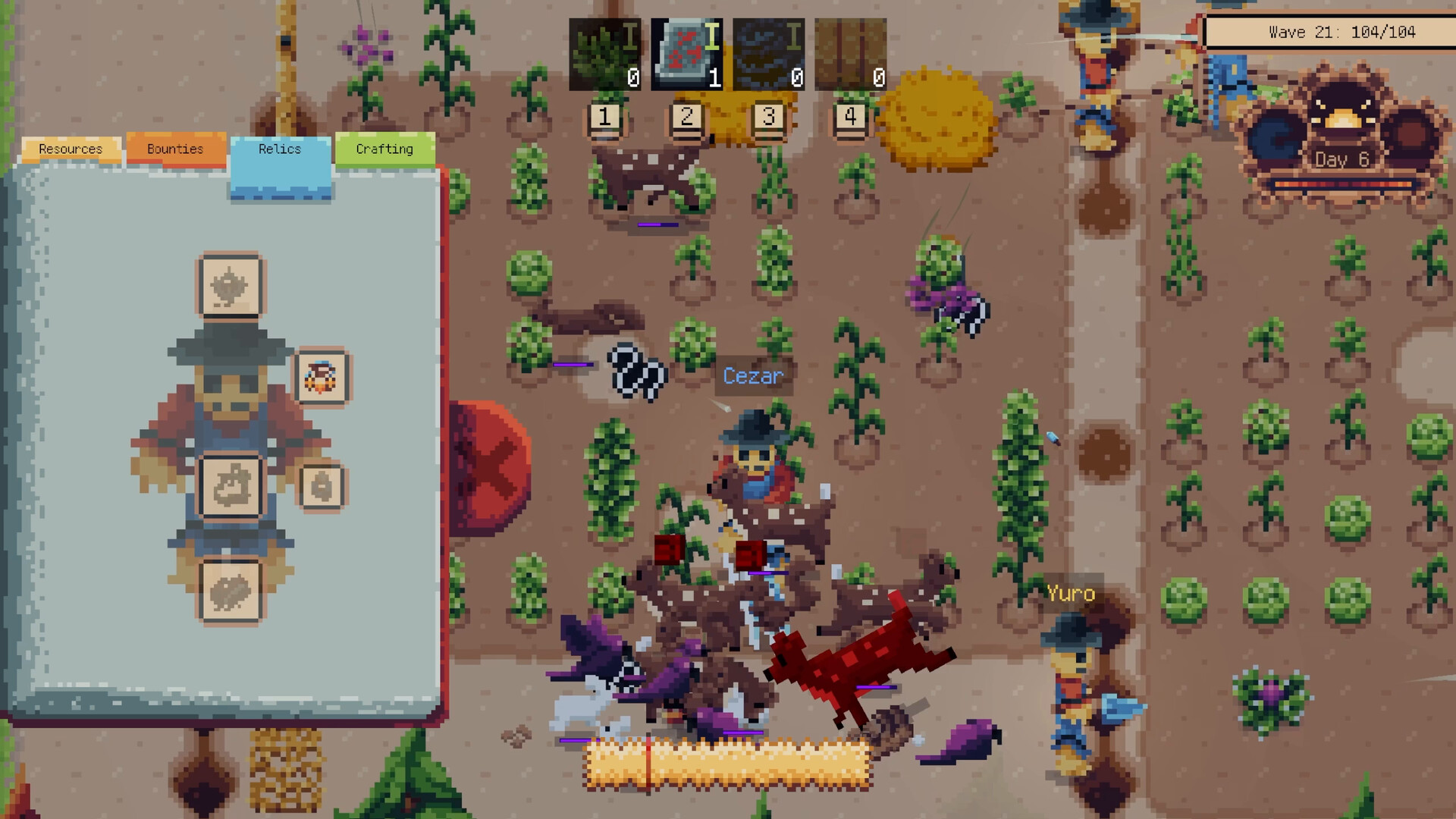
Among the more unusual features of Tattie Bogle are its buried relics, powerful objects that provide valuable bonuses alongside some potentially nasty curses. We’re rather fond of games that tempt us with powerful equipment while making us question whether the benefits are worth the trouble. Of course, balancing those rewards and punishments can be difficult, especially when a seemingly reasonable drawback turns into a nightmare. We asked Andrew whether any particular relic had caused problems serious enough to require major changes.
I wouldn’t say any of them needed a full rework, but The Red Shoes come close. You get free movement and a speed boost, but the curse sends skeletons after you every night, and we first had them running way too fast. It turns out there’s such a thing as skeletons running too fast, and it’s pretty terrifying.
The thought of being chased across a farm by ridiculously fast skeletons is amusing enough, although we’re sure the experience becomes considerably less funny when we’re the ones trying to escape. We might have preferred to see those original skeletons in action, if only to discover just how terrifying they really were.
Players won’t necessarily have to face all these supernatural problems alone.

Four Scarecrows Are Better Than One… Probably
Tattie Bogle supports cooperative play for up to four players, allowing friends to work together to protect the farm. Enemy waves become more demanding as additional players join, so bringing a few companions along won’t necessarily make survival easier. We were particularly interested in how the developers handled enemy targeting and battlefield visibility when several players are running around, building defenses, and fighting creatures at the same time. As Andrew explained, cooperation works a little differently from what we might expect.
Honestly, even in co-op, players mostly focus on their own actions and don’t pay much attention to where everyone else is on the field. A lot of the strategy and cooperation happens between cycles. Then during the cycle, you’re all judging each other on how well you pulled off whatever you agreed to go for that session. I think that’s fine. There’s no in-game chat, so co-op is really meant to be played over Discord with friends you know.
Up until maybe the very late game, when there are swarms and swarms of enemies, the map stays fairly readable, and enemy targeting is still manageable depending on your layout. Compared to solo, it actually feels very similar.
We can already imagine the arguments that might follow a particularly disastrous night. Everybody agrees on a carefully considered strategy, only for somebody to get distracted by crafting or harvesting while the rest of the team struggles to keep the pests under control. With no built-in chat, the developers are clearly expecting groups of friends to communicate through Discord, which seems appropriate for a game where planning is important but following those plans might be another story.
Finding the Right Balance Between Ambition and Reality
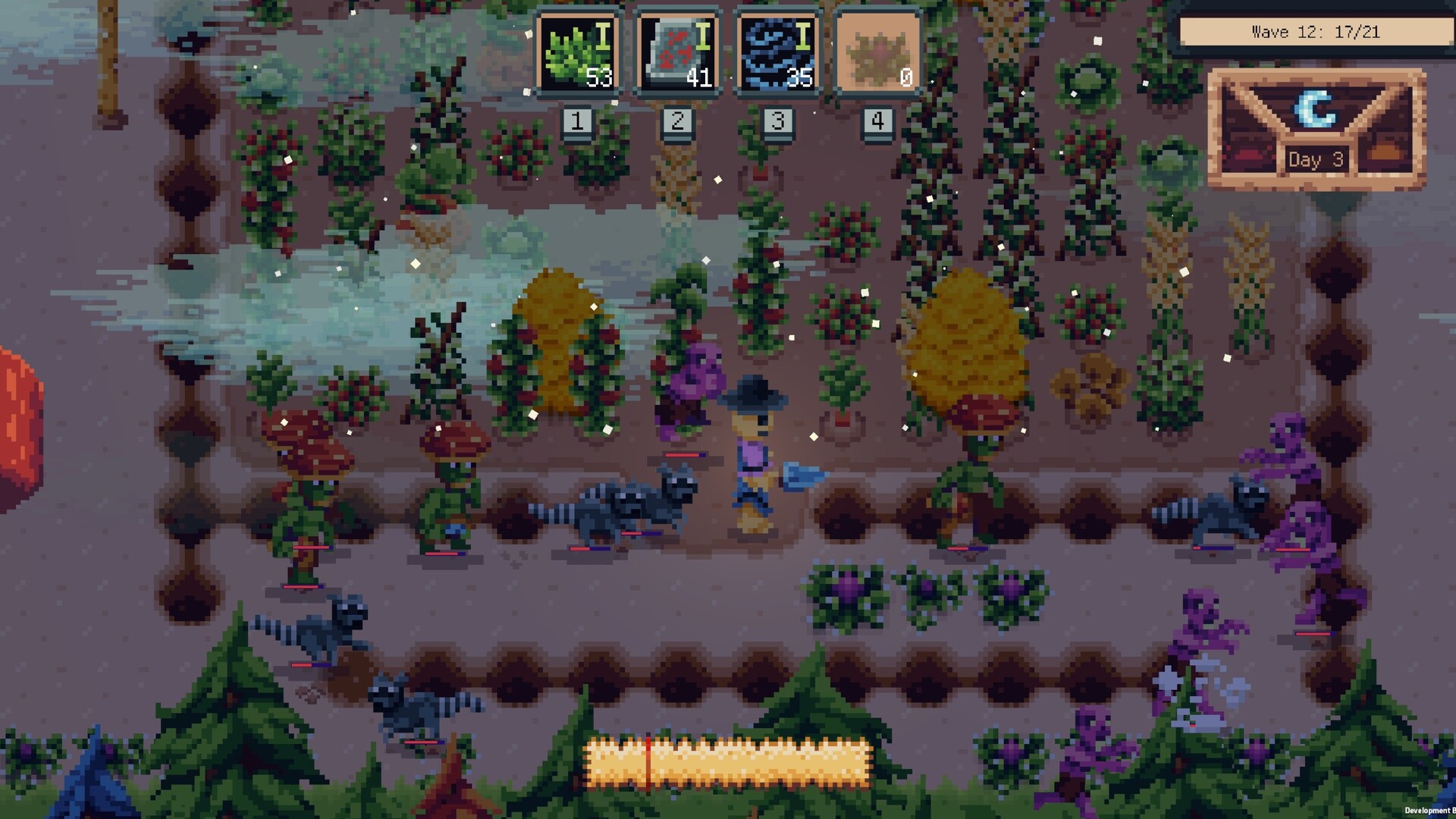
Combining farming, crafting, resource management, action combat, and tower defense sounds like quite an undertaking for a small independent studio. Each of these systems has its own rules and balancing requirements, and changing one mechanic can easily affect several others. We wanted to finish our conversation by learning a little more about Andrew’s development philosophy, particularly how he approached a project with so many interconnected elements and what other indie developers might learn from his experience.
His answer also revealed that Tattie Bogle grew out of plans for a considerably larger game, with the current project concentrating on a more manageable selection of mechanics.
I don’t think there’s a perfect way to come into a project, and I’m sure it’s fine to start with a genre in mind. I just like to start with an idea and add mechanics over time as I come up with fun scenarios, and the genre starts to show up on its own. With Tattie Bogle, it was more about paring down a much larger game I’d like to build someday. I pulled out the more action-oriented elements without completely giving up the other mechanics.
I’d also say that when you add a new mechanic, there’s often more you can do with it than first meets the eye. It’s a lot cheaper to reuse the same mechanic in a few different scenarios than to add several similar ones. That naturally leads to a more refined set of systems, which starts to give your game its own signature and feel.
We think that’s valuable advice for independent developers who might be tempted to keep adding features as their projects grow. Working with a smaller collection of well-developed mechanics can be far more practical than trying to accommodate every idea that comes along. Andrew’s comments also make us curious about the larger project he originally envisioned and whether he’ll eventually return to it.

For now, though, we’re looking forward to seeing how Tattie Bogle turns out when it launches on PC via Steam on November 11, 2026. A playable demo is already available for anyone curious about life as a magical scarecrow. Just remember to keep an eye on the farm’s finances, and perhaps think twice before putting on a suspicious pair of red shoes.


Leave a Reply