

We spent a lot of time doodling in notebooks as kids. We remember drawing strange shapes, little characters, and whatever else came to mind. But what if those drawings could come to life, obeying the laws of physics in the process? That’s the idea behind Doodle, Please!, a charming puzzle game released for iPhone on October 13. With 90 puzzles, six islands, and plenty of opportunities to experiment, the game invites us to solve problems using our imagination and a virtual pencil. We spoke with Ivan, the developer behind Doodle, Please!, about the inspiration for the game, the challenges of making drawings behave properly, and why he fully expects players to break everything he’s created.
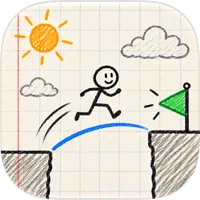
Bringing Childhood Drawings to Life
The concept sounds straightforward enough. Draw a line, and it becomes a bridge. Close a shape, and we have an object that can interact with the world. Of course, getting all those drawings to behave naturally is another matter, particularly when a little character has to navigate whatever strange inventions players come up with. We asked Ivan about the biggest technical challenge and where the original idea came from.
Crayon Physics Deluxe really impressed me with its mechanics when I was a kid. I wanted to develop that idea in a portrait format for phones, with the feeling of a little pocket notebook from childhood.
The hardest part turned out to be the character’s behavior, because the player doesn’t control him directly. It took a lot of balancing to get him to choose which direction to move and make proper use of whatever mechanisms the player invents.
With ropes, nails, weights, and rotating mechanisms available, we imagine some players will build elaborate contraptions when a simple ramp might have done the job. Naturally, we wanted to hear about the strangest solutions Ivan had encountered during development. Unfortunately, he wasn’t quite ready to spoil the surprises.
Sometimes he gets up to some really funny things. You should definitely try it for yourself!
Fair enough! We suppose discovering what the little fellow gets up to is part of the fun.

A Little Character With a Mind of His Own
One detail we found particularly interesting is that we don’t directly control the character. We draw the environment, create mechanisms, and hope our little friend figures out what to do with them. Considering how unpredictable physics can be, we wondered whether this approach might occasionally test players’ patience. Ivan explained why he prefers indirect control and how humour helps make failed experiments more entertaining.
A core idea behind my games is portrait-mode gameplay with one finger. To me, that’s the simplest and most comfortable control scheme. The drawing-and-physics idea came first, and the character emerged during prototyping. I find it interesting to take direct control away from the player.
Unexpected physics can bring out all sorts of emotions, but the first surprise is usually funny. That’s why the character, and even his deaths, are comical and lighthearted. It’s just one of a thousand experiments. For me, the important thing was to make sure a level could be solved, but not necessarily in the most obvious way.
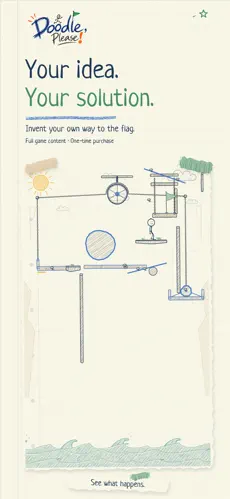
There’s plenty of room for creativity, although the puzzles still need to provide a reasonable challenge. Across 90 levels, new mechanisms gradually become available, offering more possibilities for reaching that elusive green flag. We asked Ivan how he approached the difficulty curve, especially when players might discover solutions he never considered.
As you progress, new mechanisms and new ways of interacting with physics appear. That could actually make the game easier, because there were so many ways to solve a level. That’s why the mechanisms and the character have their own limitations, and the most obvious route often leads to failure.
It sounds like we’ll have to experiment rather than rely on the first solution that comes to mind. We quite like that approach, even if it means watching our carefully constructed bridges collapse a few more times than we’d prefer.
A Notebook That Fits in Your Pocket
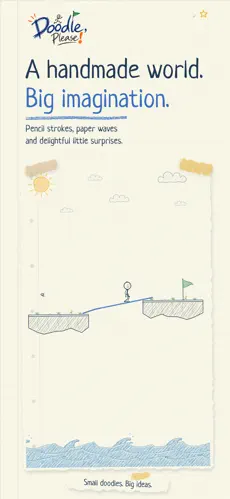
The game’s visual presentation is equally charming. Everything looks as though it belongs in a school notebook, complete with pencil drawings, hatching, and little paper decorations. It’s a pleasant change from the elaborate interfaces we’re used to seeing in mobile games. We asked Ivan why he chose this particular style and whether designing for smaller iPhone screens required any compromises.
That’s the central idea: getting away from modern graphics, interfaces, and gacha mechanics. This is a game for people who are tired of mobile games and would rather just doodle in a notebook. Add physics to that, and for me, it’s the ideal formula!
Screen size is the main challenge in designing this game. Some levels may feel a little cramped. That’s the result of a compromise between how many mechanisms are on screen and how large everything can be.
Keeping the notebook feeling while squeezing increasingly complicated puzzles onto a phone screen certainly sounds challenging. Still, the emphasis on simple controls and a familiar drawing style helps explain what Ivan wants his game to be: a small playground where players can enjoy experimenting without unnecessary complications.
Players Will Always Find a Way to Break Things
For our final question, we wanted to know what developing such an open-ended puzzle game had taught Ivan. Allowing players to draw almost anything must create some interesting problems, particularly when developers can’t possibly predict every contraption somebody might invent. His answer was amusing, but it also contained useful advice for other independent developers.
First, the player will find a way to break the game. Always! So what I’ve learned is that in open-ended puzzles like this, it’s important to find a balance between the restrictions and how obvious the solution is. I think the first few weeks will bring useful feedback, and later patches will help improve the experience both on a first playthrough and when revisiting the game.
We rather appreciate that philosophy. Players will always experiment, test boundaries, and find ways to do things that nobody expected. For a game built around creativity, allowing that freedom while keeping the puzzles enjoyable is especially important.
Doodle, Please! is available now for iPhone, with the first six levels free and the remaining 84 unlockable through a one-time purchase. If you’ve ever wanted to turn your notebook doodles into working machines, this might be a rather entertaining way to find out how good an engineer you really are.


Leave a Reply