
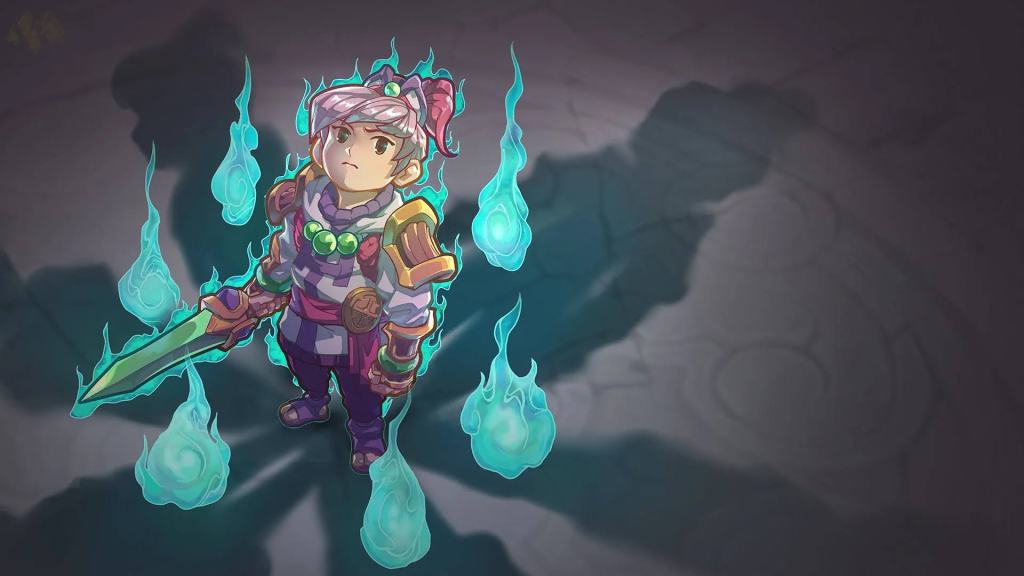
Nothing Lost, the debut action-roguelike from Team Trifold is based on the idea that the heroes who die in the Tower of Souls leave behind powers that their successors can use. A bad run, therefore, might still be useful to someone.
Team Trifold is a small studio in Christchurch, New Zealand, established with support from DREDGE developer Black Salt Games. We spoke with artist and writer Jed Uy and Wilson Teo, who handles production and QA, about making death part of progression, keeping combat fair, and questioning a few familiar roguelike rules along the way.
What Our Fallen Heroes Leave Behind
Rather than depending on a single powerful predecessor, the game is designed around generations of shamans adding to what came before. Jed explained how even a collection of weaker spirits can eventually become valuable.
Our system promotes the idea of iteratively compounding powers/perks from your characters over many runs. Even if a sufficiently powerful spirit is not available to you, you will be able to craft one from your succession of weaker spirits.
That raises a problem for the later parts of the Tower. What happens when our latest hero reaches a tough area and the spirits available there simply aren’t strong enough? Wilson didn’t pretend the team had every detail solved.
Great question. It’s an ongoing issue we’re still figuring out. We do have a design in place for those situations, and hopefully playtesting will help us solve it. Stay tuned.

There’s also the question of where the fallen heroes appear. If players could repeatedly leave powerful spirits on the earliest floors, the whole progression system might become rather easy to exploit. Wilson described the limits the team is building into those encounters.
In short, our current spawning logic considers each spirit type individually, applying distinct weightings to balance their spawn rates. However, there will always be a limit on the number of “fallen heroes” spawned and this limit may vary by floor.
Wilson also explained how the team limits the combinations players can create with three souls. Their current answer involves talent slots, with more room to develop a soul earned through the story and currency.
We’re planning to have more “distinct souls,” each unique from one another. Each soul will have a hard cap on its “talent slots,” and those slots are unlocked through story progression and spending of currency.
Power Is No Substitute for Skill
Inherited powers are an important part of Nothing Lost, but the team doesn’t want a strong collection of souls to do all the fighting for us. Jed and the lead programmer worked on their own animation tools to make attacks and abilities feel responsive, while keeping encounters readable no matter what we’ve equipped.
We developed robust in-house animation tools that allow for easy configuration of animation-cancelling windows, among other things. Myself and our lead programmer worked together for some time to get this feeling just right.
As a team we prioritized a fundamentally skill-based combat system, wherein combat always felt fair and challenging despite whatever soul loadout the player had. We never wanted the player to feel that they were at the total mercy of RNG or our underlying rogue-lite loop.

The interface had to make those combinations understandable, too. Jed described several ideas for showing spiritual powers, including an idea inspired by a certain beloved Final Fantasy system.
We drafted several different visualisations, including cards/tiles, diegetic VFX-driven visuals, and even a system inspired by the Final Fantasy X ‘Sphere Grid’! In the end, the slot-based system we arrived at felt the most visually intuitive, and served our modular, mix-and-match gameplay the best.
Finding a spirit in a dangerous room creates a different problem: we may need time to examine it while enemies are still trying to kill us. Wilson explained that wandering spirits are currently placed by hand within generated sections of the Tower, although the team is considering safer places for those meetings.
Wandering spirits are currently placed manually within generated chunks. However, we’re exploring a different approach (something like a safe zone) where players won’t be attacked or interrupted by enemies and can safely take a break and complete spirit interactions.
Changing a Rule Everyone Knows
Behind all the individual systems sits a bigger challenge. Roguelikes have spent years teaching us that death carries a cost. Team Trifold is trying to make failure contribute to the next attempt without removing the satisfaction of overcoming a difficult fight. Jed described how uncomfortable it can be to question a rule that feels so established.
Attempting to challenge the fundamental concepts of an established genre (removing the punitive aspect of death in a roguelike) will always be uncomfortable and counterintuitive. In our design discussions, it always felt like we were fighting against the current, and all of our preconceived game design ideas were confronted and tested.
In this kind of position, I would advise others to be disciplined in their creative process (design pillars!!) but to exercise flexibility in their approach to the details.
It’s an ambitious problem for a debut game, and we appreciate that the team is open about the ideas still being tested. If Nothing Lost succeeds, perhaps our next doomed shaman will have our previous failures to thank. We’d like to thank Jed and Wilson for speaking with us, and we’ll leave the final word to Jed.
On behalf of Team Trifold, thank you for supporting our debut title. Spirits be with you!
Nothing Lost is in development for PC, with its release date still to be announced. It is available to wishlist on Steam.


Leave a Reply