
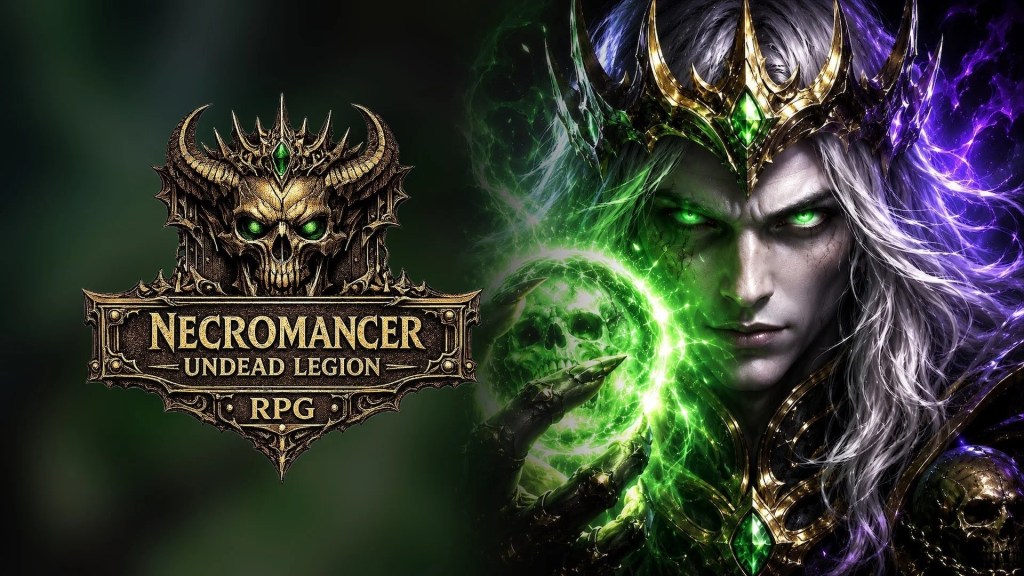
In Necromancer: Undead Legion RPG, the enemies we defeat don’t stay dead. We can resurrect them to fight alongside us, blow up their corpses, or absorb them to become more powerful. Meanwhile, we’re moving, attacking, teleporting, and commanding our growing undead army, all from a touchscreen. There’s quite a lot going on and, to make matters even more interesting, it’s all done by one person.
South Korean developer Ingyoon An of Ancoach Studio has spent more than two years rebuilding his earlier game for Android and iOS. We spoke with him about why he decided to start over, how feedback from returning players helped improve the experience, and some of the challenges he faced while developing everything on his own.
Bringing the Dead Back to Life
You started learning to code in 2022, and Necromancer: Undead Legion RPG is a complete rebuild of your earlier game. Looking back, which mechanic or design decision did you most want to change, and why?
The relationship between the necromancer and the army was what I most wanted to develop further. I love the moment when an enemy you have just defeated becomes an ally. But I also want the player to feel involved in the battle: moving the necromancer, attacking, teleporting, and deciding what to do with the bodies left behind. Building the army and fighting alongside it should feel like parts of the same experience.
I began teaching myself to code in 2022, and my earlier Necromancer RPG grew out of that period of learning. So, just to clarify the date, 2022 is when I started learning; I wouldn’t use it here as a confirmed release date for the earlier game. That game had weaknesses that came from my inexperience, but players found it and became deeply attached to it. Their response convinced me that the core idea was worth returning to.
With the rebuild, I wanted to use what I had learned to make that experience more carefully, rather than simply patch individual problems in the old game. I’ve spent more than two years developing and refining this new version. The goal is still very personal: go hunting with your legion, find equipment, grow stronger, and want to take on the next challenge.

One of the more interesting parts of combat is deciding what to do with the bodies of defeated enemies. Raising them strengthens our army, detonating them damages nearby enemies, and absorbing them helps us transform into the Reaper. Naturally, we were curious how Ingyoon managed to keep all three options useful.
I think about the three options in terms of what you need from the next moment of combat. Raising a fallen enemy strengthens the force fighting beside you. A corpse explosion turns that opportunity into immediate damage against enemies still alive. Absorbing corpses helps prepare Reaper Form; if you’re already transformed, it can extend the transformation within its duration limit.
Those are different kinds of value: another ally, an immediate attack, or power for a transformation. The interesting decision is whether you need to build up your army, break through the enemies in front of you, or prepare for the next burst of power. I don’t want one answer to be right in every situation.
There is also a detail worth clarifying: absorption isn’t the only action that contributes to the Reaper gauge. Summoning and corpse explosions contribute as well. I want the systems to work together, so using the necromancer’s other abilities doesn’t feel like abandoning the transformation system. I wouldn’t claim that balance is ever finished; the aim is to keep the choices meaningful as equipment and the situation change.

Two Thumbs, One Undead Army
Controlling a growing army while fighting enemies ourselves sounds demanding enough with a keyboard and mouse. On a phone, things become even more complicated, especially when the game requires quick movement and careful positioning. During testing, Ingyoon discovered that even the placement of a single button could cause problems.
The hardest part was the bottom-of-screen layout for commanding an army with two thumbs. Movement is on the left; attack, teleport and skills are on the right. But the “comfortable spot” turned out to be different for everyone, depending on hand size and grip. Testers asked to rearrange it, so I added three presets: Default, Right-hand cluster and Left-handed. I also moved auto-attack out of the settings menu and onto a lantern button you can toggle mid-fight.
Right after I introduced the presets in testing, a long-time tester told me the right-hand layout actually put the teleport button under the left thumb. He was right. Lifting your movement thumb to press it dropped the direction input, so you’d blink the wrong way. I swapped attack and teleport. Controls are something you can never finish testing alone.
The returning players have been a big help throughout development. Some were so invested in the project that they continued testing and reporting problems long after their first experiences with the original game. One player even managed to spot an issue that Ingyoon initially thought might not exist.
One tester told me that with the full Charnel Liturgy set, the curse zone “kept landing where there were no enemies.” I half-suspected it was just a feeling. But the code confirmed it: the zone spawned on the oldest corpse, not where the fight was. He caught something the numbers would never show, purely by feel. Now it appears where the corpse explosion hit the most enemies.
Players from my previous game came back years later to test this one, and one of them alone sent over 1,000 pieces of feedback. A lot of this game was built with them.

Fifteen Languages and One Developer
Beyond combat and controls, Ingyoon also had to deal with the technical challenges of bringing the game to players around the world. Necromancer: Undead Legion RPG supports 15 languages, which is quite an undertaking for a solo developer. Some of them, particularly Hindi and Thai, required considerably more work than adding translated text.
I had to separate having the right characters in a font from displaying those characters correctly. They aren’t the same problem. For Thai and Hindi, the project uses dedicated fonts rather than relying on the Latin font to cover everything.
Hindi needed an additional shaping step. A word can’t always be rendered correctly by placing its Unicode characters next to one another: characters can combine and their displayed forms and positions can change. I built an editor tool that uses CoreText on macOS to shape the Hindi strings, then bakes the required glyphs and placement information into an atlas and mapping that the game can use with TextMeshPro.
At runtime, the localization system applies that prepared version only when the source string matches the string that was baked. That matters because a translation edit can invalidate the prepared text: I need to rebuild the data and check the result again. This is a project-specific solution, not a claim that every TextMeshPro setup handles Hindi this way automatically.
For me, the practical lesson is to make a repeatable tool for the problem instead of fixing every label by hand. A language appearing in a dropdown isn’t enough; the text actually shown to players has to be readable. Font coverage, shaping, and fitting the text into the interface all need attention.

Making Reincarnation Worthwhile
Another important change concerns reincarnation. In the rebuilt game, players can choose when to begin another run while keeping their undead army, equipment, and other permanent progress. We wanted to know what led Ingyoon to reconsider this system and what he learned from the process.
I think the important distinction is between beginning another run and losing the things that made the journey yours. In the current design, the player chooses reincarnation. The legion, equipment, gold, and persistent progression remain. The current run’s level, experience, and stage progression are reset, with an inheritance system carrying selected growth into the next run. It isn’t a system where literally everything is retained.
What I take from that design is that a reset needs a reason the player can look forward to. I want someone to think, “What can I build on in the next run?” rather than feel that the time spent on this one has been dismissed. Collecting and developing the army is a big part of the game’s appeal, so that lasting attachment matters to me.
My advice would be to define clearly what a run is allowed to reset, what the player should be able to keep, and why starting again is useful. Then make those boundaries understandable before the player commits. A progression system should help players see their next goal, and the reset should serve that goal.

Necromancer: Undead Legion RPG is still in development, with pre-registration available on Google Play and pre-orders open on the App Store.
We’d like to thank Ingyoon for taking the time to answer our questions and share so much about his development process. It’s encouraging to hear how many players have stayed with his work over the years, and we’re looking forward to seeing how his new undead army turns out.


Leave a Reply