
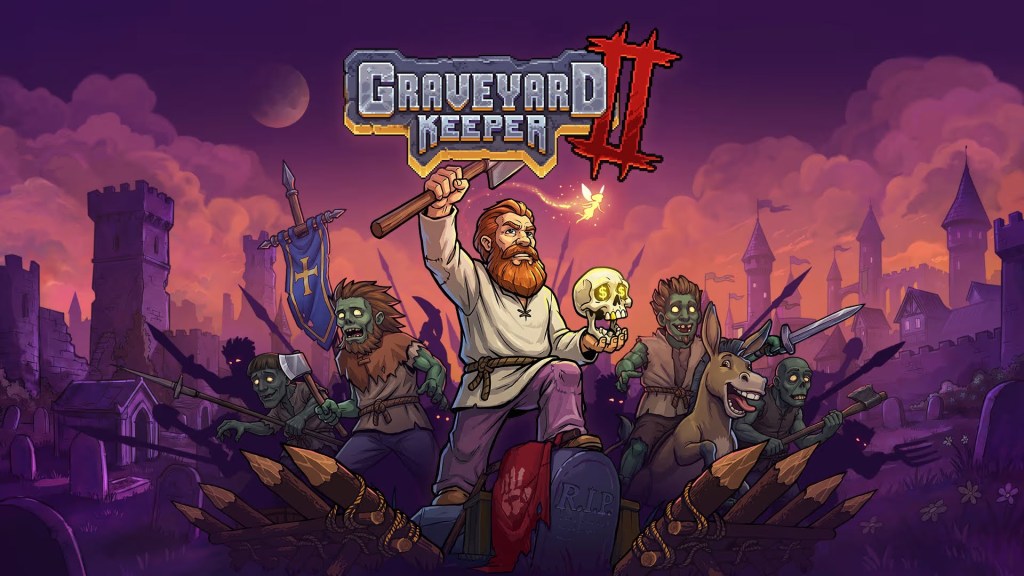
Graveyard Keeper came at a time when we were absolutely fed up with farming games and their same old, rather worn-out gameplay mechanics. It caught us completely by surprise. We didn’t expect to be dealing with corpses, digging graves, removing organs and finding increasingly questionable ways to make money from the dead. Did we find it strange, funny and, at times, needlessly complicated? Yeah, but the morbid fascination that came from all of this was also part of its charm. We never imagined we’d have a job nobody in their right mind would want and, yet, we had an absolute blast running a medieval graveyard.
It’s because of those reasons that we couldn’t wait for Graveyard Keeper 2. It turns out the devs have been quite busy taking that same idea and expanding it far beyond graveyard management, giving us control over practically everything around it. It’s a much bigger game that now includes farming, crafting, alchemy, town restoration, zombie workers, automation and even battles against the undead. That’s quite a list, so we hope you have your coffee ready. After the trailer, we couldn’t wait to explore all of this in greater depth with you.
There is always another job waiting
The second game is still recognisably Graveyard Keeper, and we didn’t waste any time jumping at the opportunity to gather resources, improve the graveyard, deal with corpses, unlock technologies and turn raw materials into products that we never thought could, or perhaps should, be products. The difference is that these systems now feed into one another much more organically.

A resource can become part of another crafting recipe, which, in turn, can be needed for a new workstation. That same workstation may later open up another production chain. Farming feeds into cooking and other systems, while the technology tree gradually unlocks more ways to work with the resources we’re collecting. It might sound overwhelming at first, but the opening hours do a good job of slowly introducing us to the world and its mechanics.
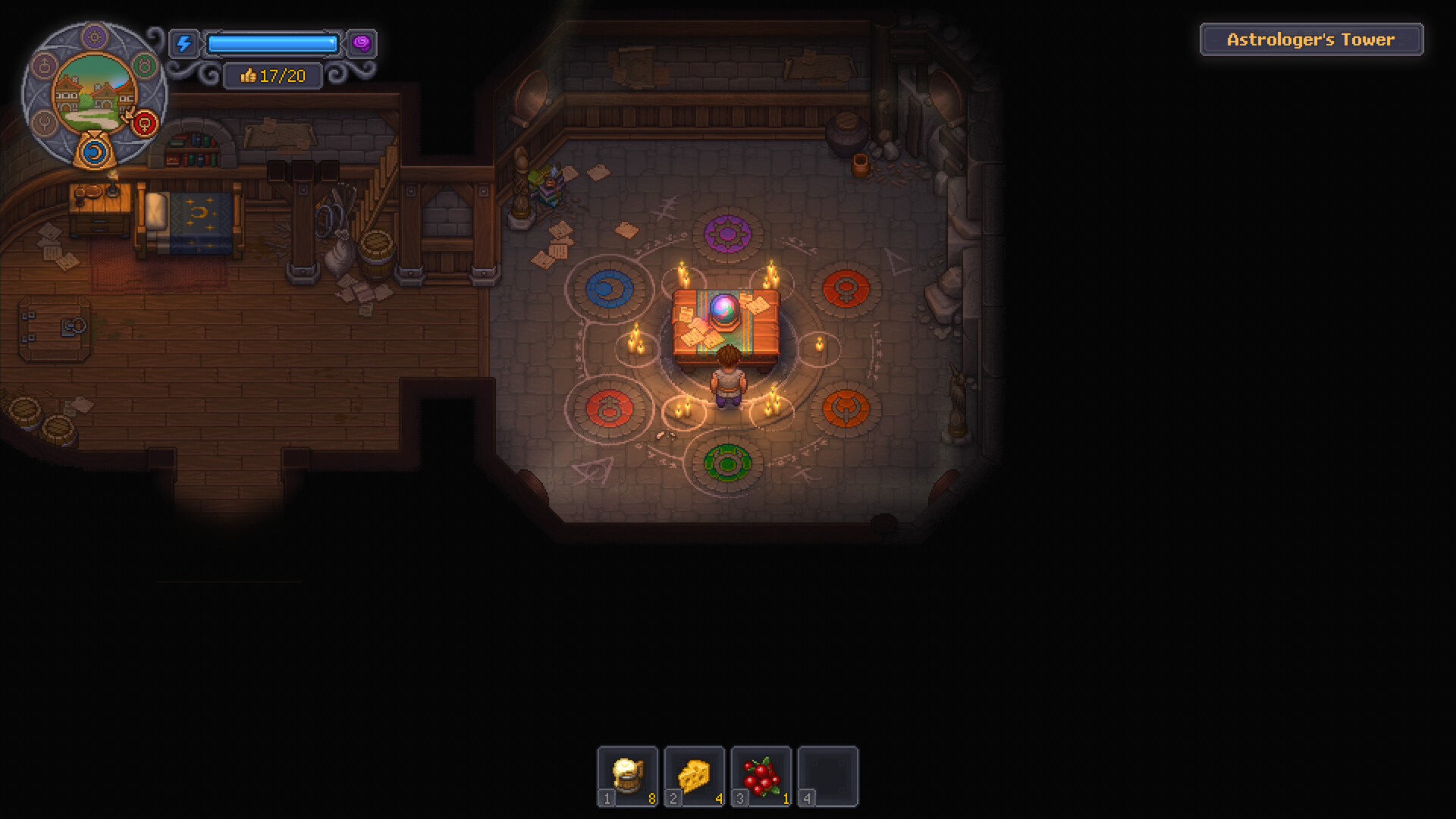
Soon, you’ll also discover that the five Mastery branches cover areas such as building, farming, smithing, book writing and anatomy. Each level invested affects what we can do and how efficiently we can do it.
Once you get to grips with all of this, collecting things becomes surprisingly satisfying because you know that almost everything can eventually become part of something much bigger. We’re building an increasingly complicated operation where the work we do early on can eventually eliminate some of the work we have to do later. It’s a game that lives by the saying: what you can do now, don’t leave for tomorrow.
Graveyard Keeper 2 hates idleness and constantly pushes us to do one thing while keeping several other things in mind. Production chains, for example, require several steps before we finally get the thing we actually wanted. This will make you decide very quickly whether you love or hate the gameplay loop.
We loved how painstakingly interconnected the systems are, but we can also see how less patient players might mistake them for a tedious affair. We don’t think there’s much of a middle ground here. You’ll most likely fall into one of two categories.
If you enjoy gradually figuring out how a complicated production line works, you have nothing to worry about. If, on the other hand, you simply want to get an item and move on with your quest, the game can make you work for it. And if you thought it couldn’t get more complex than that, well, the next part is quite the doozy.
A Proper Job for Zombies
Automation is one of the bravest and most complex mechanics in GK2. Zombies used to be enemies for us to fight. They still are, but we can now also turn them into our workforce.
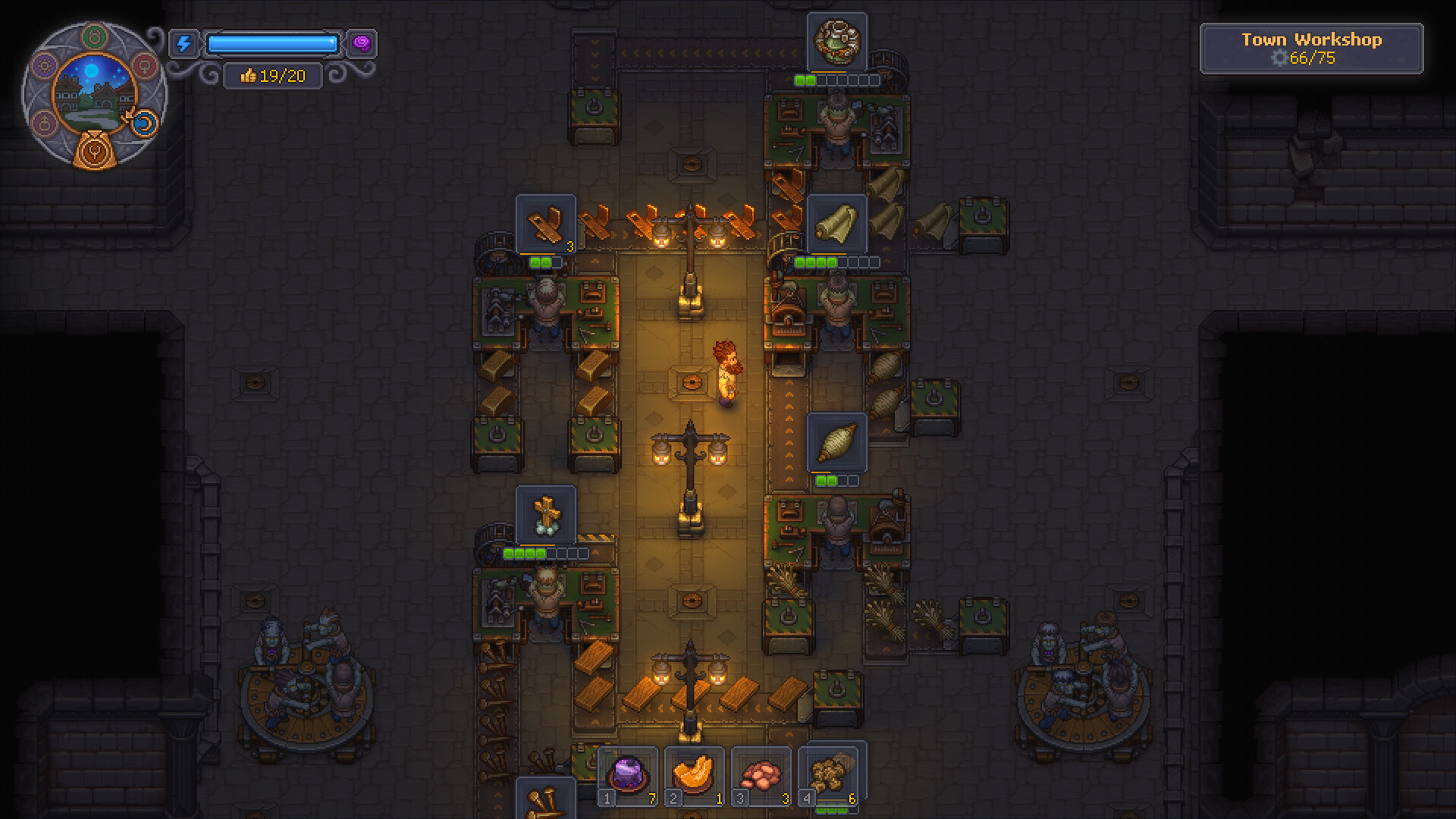
Zombies can be assigned to workstations and used to automate parts of production. Their own Mastery and equipment determine what work they can perform, while supplier stations help move materials between storage and production. They can also work without consuming our energy, which makes them an important part of the game’s long-term progression.
At first, we did everything ourselves. Later, we started handing over the jobs we didn’t want to do to our undead workforce. Once you have enough workers and the right infrastructure in place, the graveyard starts feeling like a morbid, supernatural factory where we’re spending less time personally maintaining everything and more time running the business.
As we mentioned before, a zombie still needs the right Mastery and equipment for a job, production still needs materials, and finished goods may still need to be collected. In other words, we have to build the system ourselves before we can benefit from it. Once it’s up and running, however, we can take a step back and let our macabre empire do some of the work for us.
So, if you’re up for another layer of management just so you can eventually manage the management, then, dear reader, you’re in the right place!

The Town
Graveyard Keeper 2 adds town restoration, which is yet another long-term project beyond our own property. As we help restore parts of the settlement, new shops, services and opportunities become available. They’re all waiting for us to connect our production with the wider world.
The town is also intertwined with the game’s combat systems. Certain battles take place as part of the weekly schedule, so it’s important to work on preparing troops and defences before trying to reclaim different areas. Our growing production operation now has consequences outside the graveyard, and the things we build and produce can directly contribute to our progress.
An Undead Army
In GK2, you can raise zombies that can become part of your fighting force, and this was probably the most fun part for us. We loved the strategic layer that allowed us to build defences and organise zombie squads.
Taking part in battles to reclaim parts of the town may sound like an odd addition to a graveyard management game, but that’s because it is an odd addition to a graveyard management game. It does, however, fit the game’s sense of humour remarkably well.
We certainly didn’t expect to spend so much time trying to figure out efficient ways of dealing with the dead, only to eventually put some of them on the battlefield. Somehow, it makes perfect sense in a game where turning corpses into productive members of society is considered a perfectly reasonable career path.
A Lot to Take In?!
Let’s sum up. We have technologies to unlock, Mastery branches to improve, crafting stations to build, resources to collect, zombies to train, production chains to organise, a graveyard to maintain, a town to restore and battles to prepare for.
Feels like a lot, doesn’t it?
We wish we could simply say yes, but we approached GK2 knowing most of this was coming, and we took our sweet time with it. We had the time and didn’t want to rush things. As a result, the game became a bit like an onion, revealing layer upon layer of interesting mechanics and increasingly complicated systems.
We love onions.
And, in some cases, we’re okay with grind, provided it has an addictive basis. This game has both.
GK2 gives us room to figure things out, but it also expects us to keep a lot of information in our heads. There is a certain satisfaction in finally understanding why something isn’t working and discovering the missing piece ourselves.
There is also a point where we might just want to climb to the top of a mountain and scream in frustration.
Then climb back down and get right into the game again.
A Proper Sequel?
So, we come back to the same duality we mentioned earlier. If the thought of turning a graveyard into a carefully organised production operation sounds like fun, there is a huge amount here to get stuck into.
If, however, the original game’s grind was already too much for you, the sequel is unlikely to change your mind.
Graveyard Keeper 2 takes everything that made the first game unusual and pushes it considerably further. Looking after a graveyard isn’t an easy job. Running an entire undead business is an even more complex endeavour. You’re stuck up to your neck in dead bodies, administration and plans for undead wars.
Do you really want it easy?
Score: 8/10
Game: Graveyard Keeper 2
Developer: Lazy Bear Games
Publisher: tinyBuild
Platforms: PC, PlayStation 5, Xbox Series X|S, Nintendo Switch, Nintendo Switch 2
Release Date: September 22, 2026
Genre: Simulation / RPG / Strategy / Adventure
Players: Single-player

Leave a comment