

Sitting down to review a game feels pretty straightforward. You look at the mechanics, test the gameplay, follow the story, and write down your thoughts. But every once in a while, a title crosses our path that completely throws that standard formula out the window. Celestial Return is exactly that kind of experience. Going into it, we didn’t quite know what to expect. Coming out of it, we’re still trying to process the wild ride it took us on.
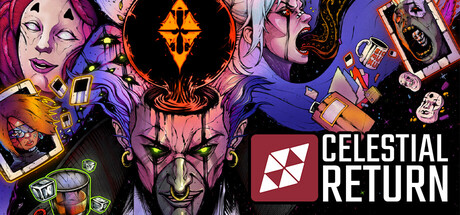
Celestial Return is one of those games where we simply don’t know where to start. Should we go with the electronic soundtrack that feels like your brain’s going to melt, or with the psychedelic art that seems like it pours out from a deeply disturbing but highly creative mind? Or should we talk about the story and how well it is written? About the complex characters and meaningful choices that stay with you long after you stop playing? We could start at any of these points, and all of them would be equally good.
Celestial Return does its best to present itself as a complex hybrid between a book and a game, with just the right amount of cinematic style. While you’re reading the text on the right and taking actions that result in different reactions, the narrative and visual exposition is strong. You hear subtle things, like gunshots, beeps, and cracks, and you see things like looping videos or comic strips. It’s all done in great detail and with a lot of taste, contributing to a rich experience. It’s criminal to call Celestial Return a visual novel and end it there. It’s more than that. It’s a collection of tools whose sole purpose is to pull you into a detailed world filled with intricacies. Once it does that, it doesn’t let go.
When you’re not reading walls of text, you’re doing challenges. Each challenge has four slots for dice. The more dice you have, the greater your chances of being successful in your endeavors. The dice you roll and the numbers you get can then be added together—you know how this goes, the higher the number, the better. As long as you don’t roll a zero, you’re golden. You can, for example, throw four dice, and if you get a big number that’s great, but that also means you’re risking more to get a zero. Zero, as we’ve established, is a bad thing indeed. It’s kryptonite to your Superman’s luck.
Hey, you want to hear another interesting fact about these dice? They disappear. So, it’s imperative to collect as many as you can by exploring and doing jobs. They are limited, and it’s your job to weigh all the options and decide when you should use them and when you should save them. This is a double-edged sword, and we’re guessing a lot of players will see this dice mechanic as a bitter pill to swallow because of their limited quantity, disappearing nature, and the unpredictability of the turns.

Considering how many choices can be made, it seems like the odds are against you. But we feel that’s the whole point with Celestial Return. The point is not to win. The point is to try, let things take a wrong turn, and then deal and live with the consequences. This unpredictability, this hanging by a thread, gives the whole game depth. In those rare situations where things do go your way, or in those situations when the shit does hit the fan and you still did the best you could, it feels amazing. The choices, such as they are, influence your character, changing them to a point where you don’t really even have a say at certain moments in the game.
Playing Celestial Return feels like an exercise in letting go of control. It’s a game that asks you to accept failure as just another turn in a very long, very strange road. We walked away from it feeling a bit battered by the dice, but completely captivated by the world it built. If you have the patience for a game that bites back, we highly recommend giving this one a shot. Just remember to hold onto those dice.

Leave a Reply