
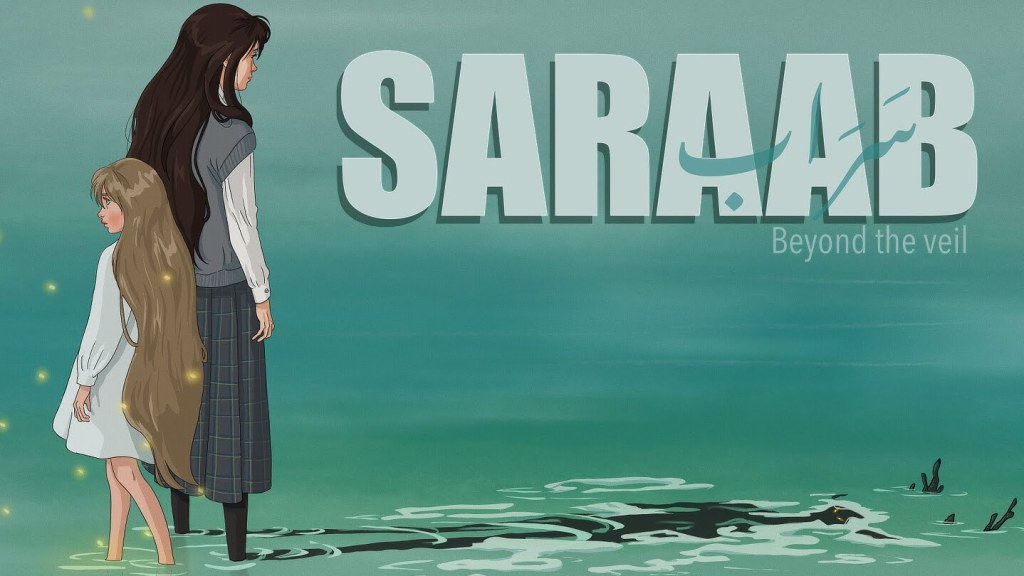
When Elham’s younger brother disappears, finding him means confronting things she would rather leave buried. Saraab: Beyond The Veil uses Arabian folklore and psychological horror to tell that story, but its supernatural encounters aren’t always what they appear to be. We spoke with solo developer Lubna Ahmed of Rooted Elevation about the Shadow and Guide who accompany Elham, writing about difficult experiences, and why she wants players to draw some conclusions for themselves.
The Folklore Behind Elham’s Fears
With so many stories about djinn to draw from, we wondered whether Ahmed had to change or leave out any legends because they didn’t fit Elham’s journey.
Not really. We didn’t end up cutting any stories. The number we included fit the number of days the story spans, so there was a natural structure for bringing them into Elham’s journey. I didn’t feel I had to fit in more folklore or leave something out just to make that structure work. It was more about how each story would be presented and how it would connect to what Elham was experiencing.

Two figures are especially important to that journey: the Shadow, which feeds on Elham’s doubts, and a mysterious Guide who urges her to face them. We asked why Ahmed chose to give those inner conflicts a form Elham could interact with, and whether we should understand the figures as supernatural beings, reflections of her mind, or perhaps both.
The spiritual presences serve both purposes. They’re part of the supernatural side of the story, but they also reflect the human psyche, particularly the higher self and the shadow. The Shadow, for example, draws on the belief in a shadow-companion djinn, while also representing something within Elham herself.
Giving those struggles a presence allows her to interact with them rather than only think about them. But I deliberately leave it up to the player to decide whether these are real presences or whether they exist in her mind. That ambiguity is important to me, because both interpretations are part of how I wanted the story to be experienced.

Horror That Has Something to Say
Saraab deals with grief, trauma and sleep paralysis, and we wanted to know how Ahmed approached subjects like these without using them merely as excuses to frighten the player.
For me, the most important thing was to highlight overcoming those experiences, rather than focusing only on the experiences themselves. The frightening moments are part of the story, but I didn’t want grief, trauma, or sleep paralysis to be there simply because they could create horror.
What mattered most was Elham’s response to what she was going through and her ability to move forward. That gave the emotional side of the story its direction. It wasn’t only about putting her through something frightening, but also about what it takes for her to confront it.
Choices are part of that journey, and the game has three possible endings. We asked Ahmed how she decided which decisions deserved lasting consequences, while keeping the outcomes consistent with Elham rather than turning her story into a test of choosing the right answers.
The distinction between the good and bad endings actually comes down to one essential choice. That decision is central to the direction of the story, so I wanted it to carry that weight rather than make the outcome depend on accumulating a certain number of “correct” answers.
The true ending then unlocks only after completing the good ending, so the three endings aren’t all available on the first playthrough. For me, keeping them consistent with Elham meant grounding that crucial decision in her struggle. The outcomes could be different, but the choice leading to them still needed to belong to her story.

Finding the Music in the Story
Ahmed has handled much of the game’s writing and music herself. She also recorded early musical ideas as voice memos, which made us wonder whether any of those melodies ended up shaping the scenes or characters she was writing.
It was more the other way around. When I was composing, I was visualising the scenes where I wanted the tracks to play. I would imagine the moment and what I wanted it to feel like, and compose with that in mind.
The early voice memos were a way of capturing those musical ideas. Rather than starting with a melody and building a character or scene around it, I was usually trying to find the sound of a scene I could already see in my head. Writing and composing were connected through that shared sense of the moment.

Letting Players Have Their Say
Working so closely on a story makes it easy to know where every decision belongs. Players coming to it for the first time don’t have that advantage, and the demo gave Ahmed a chance to hear what they wanted from the experience. We asked whether their reactions had led her to reconsider any of her creative decisions.
The feedback on the demo was positive overall. One request I heard was that players wanted more choices, and that was something I took into account in the rest of the game. It didn’t mean changing the central story, but it did mean giving players more opportunities to participate in it.
The lesson I’d take from that is to listen to feedback without feeling that you have to lose sight of your original vision. In this case, players weren’t asking for a different story. They wanted more interaction with the one they were already experiencing.
Ahmed leaves room for us to wonder what Elham is really facing. The uncertainty around the Shadow and Guide feels appropriate for a story about confronting things we don’t fully understand, including parts of ourselves. Saraab: Beyond The Veil was released for PC on Steam on November 3, 2026, and a free demo is available for anyone who wants to give it a try. We gave the visual novel a 9/10!
Follow Rooted Elevation: Instagram · Bluesky · X · TikTok · YouTube · Discord


Leave a Reply