
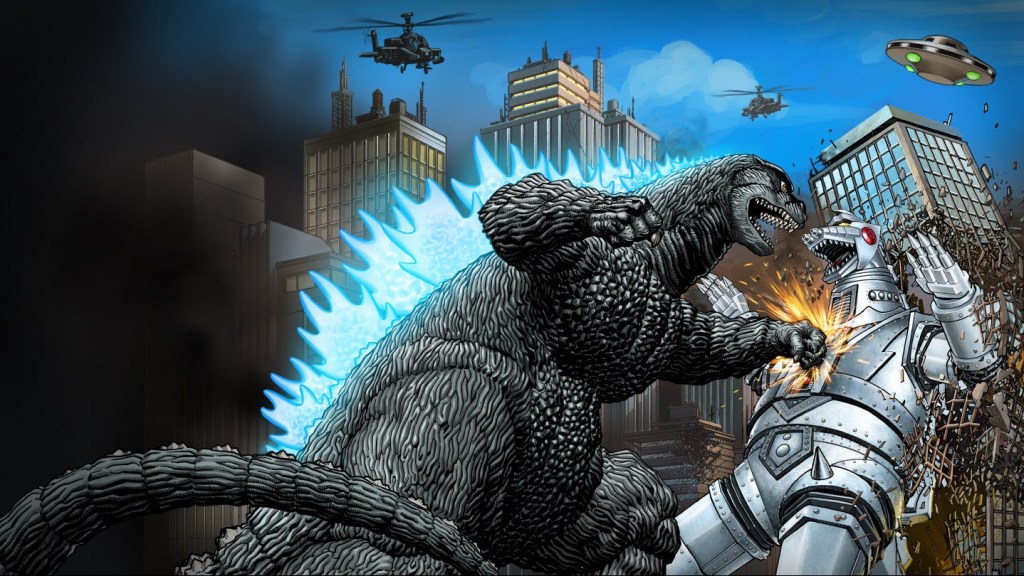
Could you kindly name us a fighting game where picking up an entire building and throwing it at your opponent is a thing? Go ahead, we’ll wait. Nothing comes to mind, right? Well, aside from Godzilla: Destroy All Monsters Melee Remastered, of course. This remaster brings back the 2002 arena fighter from Pipeworks Studios and lets us tear cities down with twelve enormous monsters. Atari and the original developers have rebuilt the game with modern graphics, introduced new single-player content, and added online multiplayer. But does this old-fashioned monster brawler have enough to offer beyond the satisfaction of watching Godzilla beat the living daylights out of his fellow kaiju? There’s only one way to find out, and it involves throwing a building at somebody.
A Whole Lot of Destruction
Combat takes place in large 3D arenas where we can move freely, exchange punches and kicks, grapple with opponents, and unleash devastating energy attacks. The controls are relatively straightforward. As people who are terrible at combos, we loved being able to jump into a fight without having to memorize complicated button combinations. Heavy attacks can send opponents flying, while grabbing another monster allows us to slam it into nearby structures. We can, as we mentioned in our intro, even pick up buildings and hurl them at enemies. Tell us that doesn’t sound like a wonderful use of urban infrastructure.
The twelve playable monsters have their own strengths and weaknesses. Godzilla is a balanced fighter whose atomic attacks and powerful tail make him our first choice. Gigan is considerably faster and can teleport, which is great for closing distances or escaping dangerous situations. Megalon can burrow underground and emerge beneath an opponent to grab them, while Anguirus (or Angu-something-dede, as we like to call him) has a spiked back that can damage enemies who attack while he’s blocking. We feel you get the point.

These differences become particularly important because special abilities consume energy. Another monster, for example, can keep enemies at a distance with gravity beams, but flying also drains his energy reserves. Similarly, Mechagodzilla, our second fave, by the way, has an impressive arsenal of lasers and missiles but becomes considerably less threatening when that energy runs out. There’s certainly room for tactical decision-making, even if the fighting system is nowhere near as elaborate as those found in traditional competitive fighters.
There are eight locations where we can take out our frustrations, including Tokyo, San Francisco, Monster Island, and the Vortaak mothership, with day and night variations. We’ve already mentioned that buildings can become weapons and that opponents can be thrown into structures for additional damage, but there are also alien UFOs that occasionally drop useful power-ups. One particularly amusing pickup summons an ally to perform an aerial attack. We can also trigger Rage Mode to unleash a powerful special move, provided we’ve unlocked the necessary ability.
The destructible scenery is an essential part of the spectacle, but the combat still feels like it belongs to an older game. It favours enormous, exaggerated attacks over precision, and the comparatively simple combinations mean that repetition can become noticeable after several fights.

Unlocking the Monsters
Only four monsters are available initially. The remaining baddies, along with additional arenas and gallery content, must be unlocked through the new G-Force research system. To do that, we need to investigate Rumors and complete Research Projects. Certain objectives might ask us to earn 25,000 points in Survival Mode, complete Adventure twice, or participate in four matches in San Francisco. Each battle contributes research points towards an active project, and we can choose which reward to work towards first. It’s more flexible than the original unlocking system, but we didn’t particularly enjoy having to repeat matches just to access most of the roster. It felt unnecessarily restrictive, especially for a game built around quick and accessible fights.
The monsters also gain experience and improve their abilities in single-player modes. More demanding Adventure Gauntlet battles become available at level four. At level seven, each character gains access to a unique Adventure Challenge, with scenarios involving everything from time travel to kaiju gladiators. We appreciated having a few additional things to work towards, although we would’ve preferred having more monsters available from the beginning.

Oldie but Godie
Throwing gigantic monsters into buildings, experimenting with their different abilities, and unleashing devastating attacks across familiar cities is every bit as satisfying as it sounds. The improved presentation and additional modes are welcome, but the repetitive progression system and limited combat depth might make the package a tad less appealing to more demanding players. For Godzilla fans and anyone who enjoys a good couch multiplayer brawler, like us, there’s still plenty here to entertain the hell out of you. We just wish the game didn’t make us jump through so many hoops before letting us play with all its enormous toys.
Our score: 9/10

Game at a Glance
- Platforms: PC (Steam), PlayStation 5, Xbox Series X|S, Nintendo Switch 2
- Developer: Pipeworks Studios
- Publisher: Atari
- Genre: 3D Arena Fighting, Action
- Release: November 3, 2026
- Modes: Single-player, Local Multiplayer (up to 4 players), Online Multiplayer (1v1)


Leave a Reply