

Everyone has a Halo story. For us, Halo: Combat Evolved was the reason we invited our crush over after school, stayed up far too late on weekends, and argued over who got to drive the Warthog. Twenty-five years later, those memories still run strong, making it one of the hardest games to remake. Everyone remembers the core game a little differently, and any attempt to modernize it risks upsetting those memories. Halo: Campaign Evolved had a difficult job, but as you’ll read in our review below, it managed to pull it off with flying colors. The devs didn’t replace the original; they simply rebuilt it in Unreal Engine 5 while borrowing mechanics from later entries across the series.

Combat That Still Feels Timeless
That being said, Halo: Campaign Evolved remains about shooting aliens. The sandbox, however, has grown significantly. Developed from the ground up in Unreal Engine 5, Halo Studios yanked mechanics from across the franchise’s history and retrofitted them into the 2001 framework. We loved being able to sprint to reposition during chaotic firefights on familiar ground. Having the ability to sprint into cover drastically improved our survival rate on Heroic difficulty. For a brief moment, we entertained the thought of disabling sprint to get a purist experience, but after just one mission, we found it surprisingly difficult to go back. Such are the woes of modern spoiling. Still, the game constantly encouraged us to stay on the move, and we quickly learned that taking damage still knocks you out of scoped view. Hey, that was purist enough for us.
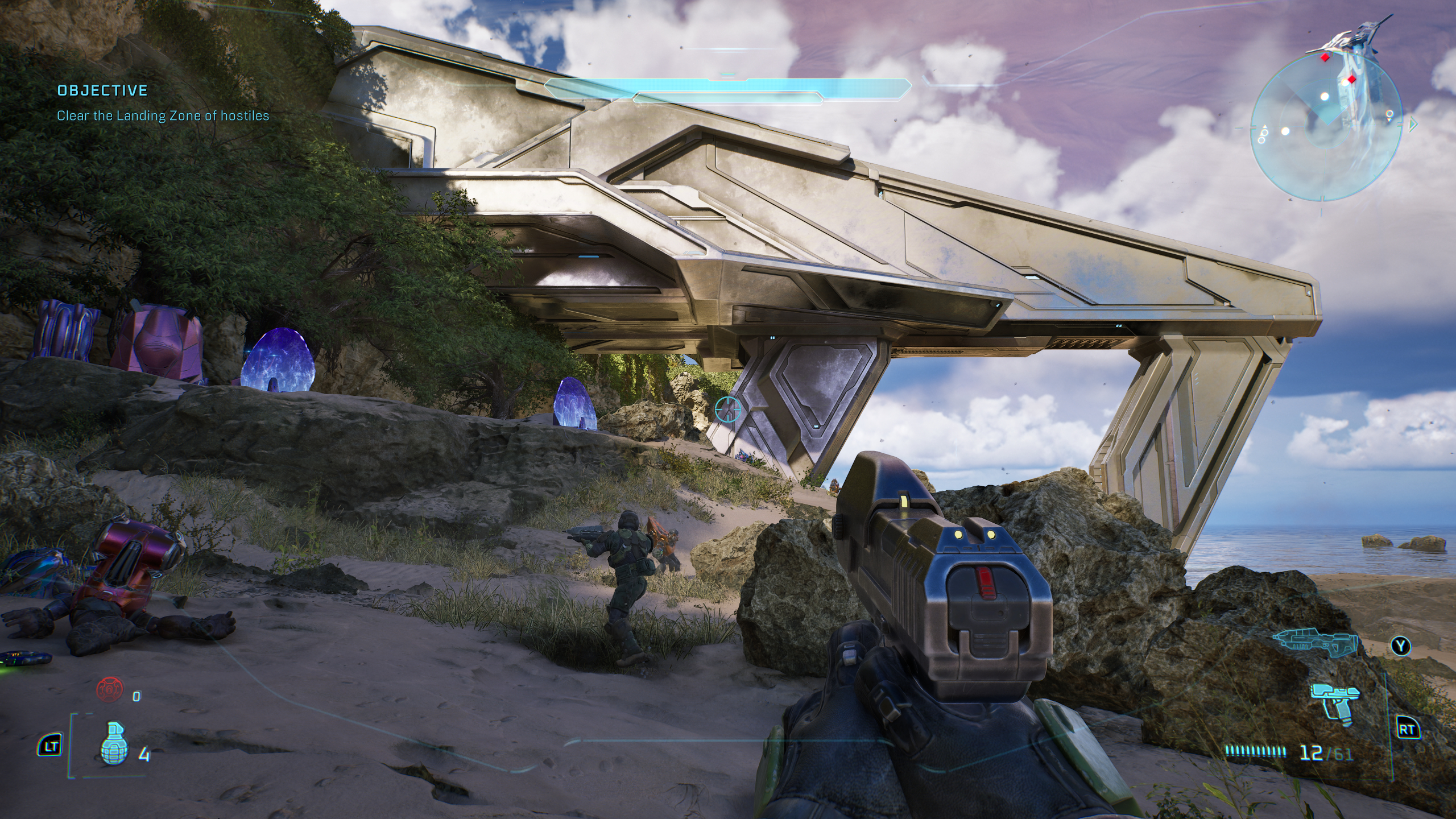
The expanded arsenal immediately changed how we approached encounters. We unlocked nine additional weapons as we progressed, and each one encouraged us to experiment. We started with the familiar Assault Rifle and Magnum combination before stumbling across a Battle Rifle resting beside a supply crate on the beaches of The Silent Cartographer. From there, we began experimenting with SMGs, Fuel Rod Cannons, Sentinel Beams, the Brute Spiker, Needle Rifle, and Beam Rifle. We never settled on a favorite because every weapon felt worth carrying.
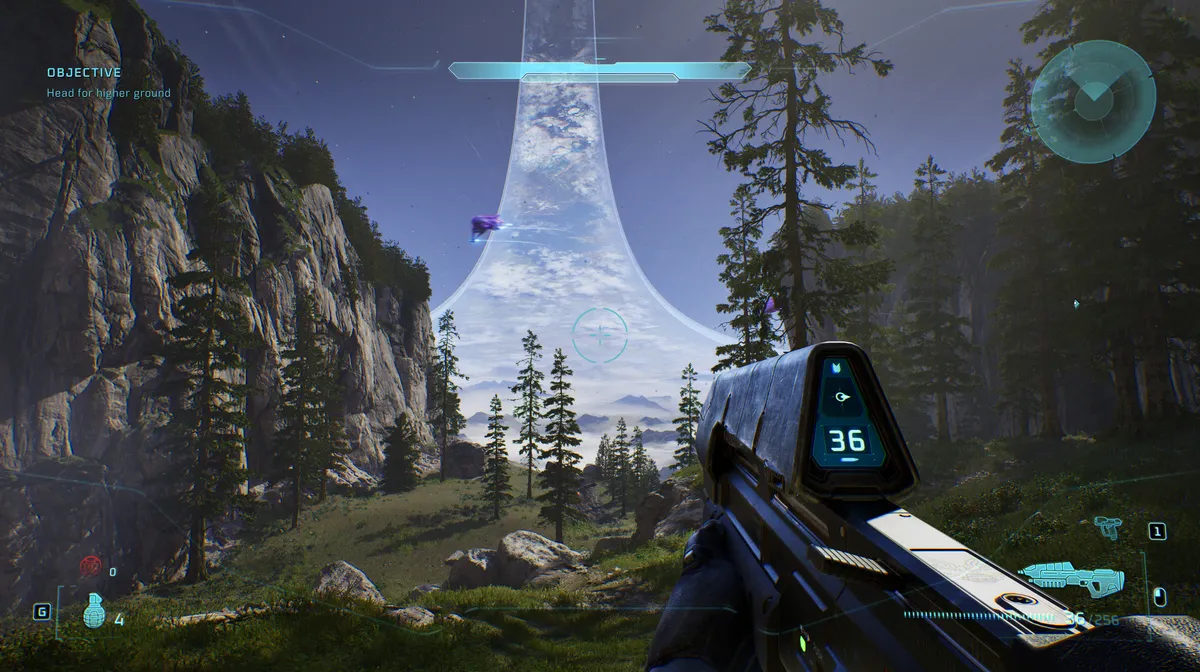
Instead of charging a pack of Grunts just to strip a Jackal’s shield with plasma fire, we could perch on a cliffside and eliminate targets one by one with a Beam Rifle. Other times, we grabbed a fallen Elite’s Energy Sword and carved through narrow corridors that once demanded a much slower approach. But it must be said that it never felt like the original combat had been replaced. The expanded weapon selection simply gave us more ways to solve familiar problems.
The reason all of this works is because Halo’s enemy AI is still excellent. The Covenant remain every bit as entertaining to fight as we remembered. Elites aggressively push your position—we remember calling them bloodthirsty hounds, and that still rings true when they sense weakness. Jackals force you to rethink your angles, and Grunts still scatter in panic after watching their commander fall. Even after all these years, encounters rarely play out the same way twice because the enemies don’t stand around waiting to be shot—they react to what you’re doing continuously.
It’s a familiar dance, but only until the Flood show up and change everything. Careful firefights against Covenant patrols suddenly become desperate battles for survival. We found ourselves paying extra attention to our aim and conserving ammo. Remember those songs of praise about the expanded arsenal? Well, it doesn’t trivialize these sections in the slightest. It gives you more options for dealing with overwhelming numbers, but the encounters still feel fresh and the tension is fully preserved.

Modernized Vehicle Combat
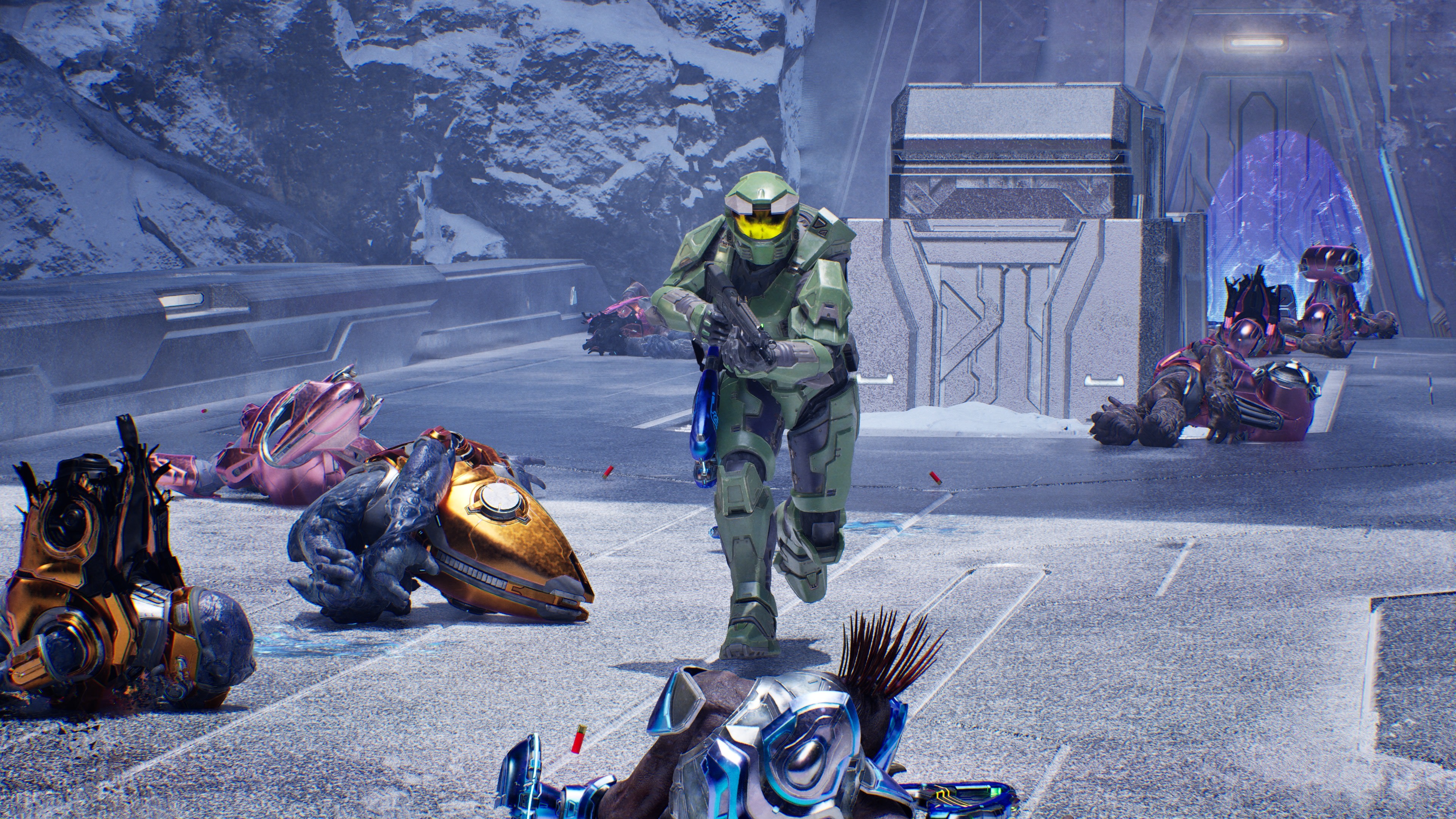
In the original release, running into heavy Covenant armor often meant hiding behind rocks while slowly whittling it down with rockets. There’s no need for that now since you have far more options. The hijacking mechanics from later Halo games have been fully integrated, and vehicles are destructible in real time. When a Wraith pinned us down in the snowy canyons, we charged a plasma pistol, disabled the tank with an overcharged shot, vaulted onto the hull, forced open the hatch, and threw the Elite pilot into the snow before turning its plasma mortar against the Covenant reinforcements. It sounds great on paper, but it feels amazing in practice, and after a few encounters it became difficult to imagine playing without it
The Warthog uses modern controls: steering with the left stick while the triggers handle acceleration. For those of us who spent years accidentally flipping a vehicle full of Marines because we nudged the camera at the wrong moment, this change alone removes a surprising amount of frustration. For diehard purists, the classic controls remain available, but as huge fans of the original, we never felt the urge to switch back.
New Reasons to Explore
We also found ourselves wandering off the critical path more often than expected. Hidden weapon caches, Skulls, and the chance to keep another Marine alive gave us reasons to poke around instead of rushing to the next objective. Those small discoveries remain just as satisfying today as they were back in 2001. This exploration is strongly encouraged by the beautiful new visual engine, which we’ll touch on shortly.
What we weren’t expecting in Halo: Campaign Evolved was completely new content. Operation: Meteorite serves as a three-mission prequel starring Sgt. Avery Johnson. You might expect these freshly designed levels to clash with the original campaign, but they feel like missions Bungie could have shipped back in 2001. We infiltrated a massive agricultural research vessel, rescued captured Marines from a fanatical faction, and reached the peak of our excitement fighting through tight corridors while searching for intelligence. The missions feel like a lost Halo expansion that somehow escaped discovery for twenty-five years.
Playing alone is enjoyable. Even though Halo has always been at its best with company, this time around we lone-wolfed the whole thing. Competitive multiplayer was removed in favor of a stronger focus on co-op play, but even so, our friends were too busy to help us tackle The Library. We did want to see how, despite everyone’s familiarity with the campaign, the expanded sandbox results in non-stop surprises. It would have been cool to experience one player commandeering a Ghost while another accidentally wakes up a room full of Flood. Then, before everyone knows it, the entire plan falls apart in the most entertaining way possible.
But we’re not complaining, as our own solo playthroughs were interesting enough. Halo Studios repositioned the hidden Skulls and introduced several new ones. One we discovered early added permanent green night vision to the visor, making enemy patrols glow in the dark inside structures. Later, we found the much-talked-about Perspective Skull, which shifts the entire campaign into a third-person view. That alone was worth it. Watching Master Chief sprint across a beachhead while Dropships unloaded reinforcements completely changed our awareness of the battlefield—even if it resulted in plenty of hilarious deaths while we adjusted to the new camera angle.
A Familiar Ring, Beautifully Rebuilt
The ring looks instantly recognizable, but noticeably richer. The first thing we noticed when stepping onto it wasn’t the higher-resolution textures; it was the atmosphere. Fog hangs over the valleys, and plasma lights up Forerunner corridors. As a result, firefights feel far moodier than they ever did in 2001. Rest assured, despite all the added effects, we never struggled to see enemy shields or incoming plasma.
We noticed the new voice acting almost immediately, and unfortunately, it wasn’t always for the better. Most cinematics feature newly recorded dialogue from the cast, but several performances lack the personality of the originals. To us, it occasionally sounded strangely flat. That’s not the case with the in-game sound design, which is excellent. Every weapon sounds much punchier, and the crackle of an Energy Sword is wonderfully aggressive. Halo’s iconic musical cues still know exactly when to swell during the campaign’s biggest moments, giving us shivers down our spines.
We reviewed the PC version on 1080p high graphics, and our RTX 4060 Ti handled everything the engine threw at it. We can’t, however, personally comment on how the PS5 version feels beyond its advertised DualSense support. The adaptive triggers and haptics give each weapon a distinct personality, making us want to try the PS5 version just to feel the Covenant plasma rifles sizzle and the shotgun land with enough force to make every Flood encounter feel appropriately brutal.
Some Things Never Change
Not every rough edge belongs to the remake, however. Some of Combat Evolved‘s original level design still shows its age. Truth and Reconciliation remains full of nearly identical purple corridors that make losing your direction surprisingly easy. Assault on the Control Room still stretches certain combat spaces longer than necessary, Two Betrayals remains an exhausting revisit of familiar locations, and while The Library is certainly more enjoyable with the expanded sandbox, it’s still The Library. No amount of modern technology can completely disguise twenty-five-year-old level design. Still, these elements are sacred to long-time fans, and we understand why the devs didn’t want to alter them too much.

After everything we experienced, we realized that Halo: Campaign Evolved isn’t trying to replace Combat Evolved. It’s a game that shows a deep understanding of why people have been returning to this campaign for decades. We’re glad the devs played it safe and knew better than to reinvent the parts that already worked. We ended up loving the expanded sandbox, smarter movement, larger arsenal, new cooperative content, and optional twists that make familiar battles feel unpredictable again. Once the shooting starts and the Covenant begin pouring over the next hill, it’s remarkably easy to remember why Halo became one of gaming’s defining shooters.
9/10 — After playing it for decades, it feels right to re-experience the whole thing in a new, modernized way. There’s zero interest in rewriting Halo’s history. Everything done in the remake is designed so the original campaign can be played not in a new way, but a better one.
- Developer: Halo Studios
- Publisher: Xbox Game Studios
- Genre: FPS Action, Co-op, Shooter, Sci-fi


Leave a Reply