
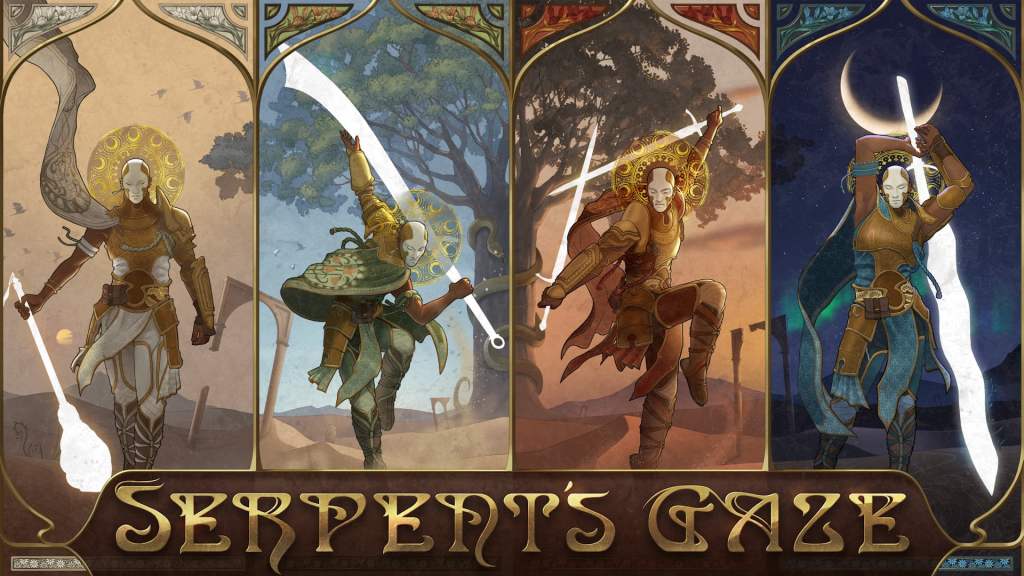
When you look at the résumés behind newly formed indie studio Feeble Minds, you see a history defined by colorful optimism and wacky chaos. With alumni who helped shape massive hits like Satisfactory and Goat Simulator—alongside experience from strategy giant Paradox Interactive—you might expect their debut title to be a sprawling, lighthearted simulation.
Instead, they are plunging players into the dark, punishing depths of Serpent’s Gaze, a hardcore, up-to-four-player co-op souls-like with a heavy roguelike twist.
It’s a massive genre pivot, but according to the team, that was exactly the point. “We’ve always liked making games of different genres,” the team explains. “Expanding our horizons with new types of games keeps the fire burning and allows us to develop a broader understanding of games in general.”
Beyond creative wanderlust, the shift was born from personal passion and practical necessity. The developers share a deep love for both souls-likes and roguelikes, noting how the latter ingeniously turns the meta-mechanic of “failing and reloading” into a core gameplay loop. Furthermore, as a new studio operating with a skeleton crew, they needed a framework that prioritized high replayability over a massive volume of raw, unique assets. But perhaps the biggest driving force was a simple, selfish desire: “We’ve also felt there is a significant lack of hard co-op focused games that we can play on our gaming night, so this is our solution to that.”
Even the studio’s evocative name, Feeble Minds, carries a certain dark, souls-like weight—though the developers are quick to undercut any perceived pretension. When asked about the philosophy behind the name, the answer is refreshingly blunt: “The name reflects our collective mental capacity.”
Blending Veterans with Fresh Blood
While the studio boasts serious industry pedigree, Feeble Minds isn’t relying on past laurels to dictate their future. They’ve intentionally built a roster that mixes grizzled veterans with fresh development talent.
“For us, what matters most is the ability to work together—having a creative workspace always comes before experience,” they emphasize. The dynamic is highly iterative, with veterans acting as pillars of support rather than dictating every move. “Everyone is involved in most parts of the project. We all learn and grow together.”
That collective growth has been channeled into a striking visual departure from their previous work. Developers Jannik and Mikael admit to a shared attraction toward “dark and twisted art,” often trying to one-up each other with creepy design ideas during the game’s early stages. “On top of that,” Jannik notes, “after working so many years on the colorful and jolly Satisfactory, we really felt we needed a change of tone!”
Handcrafted Agony Over Procedural Generation
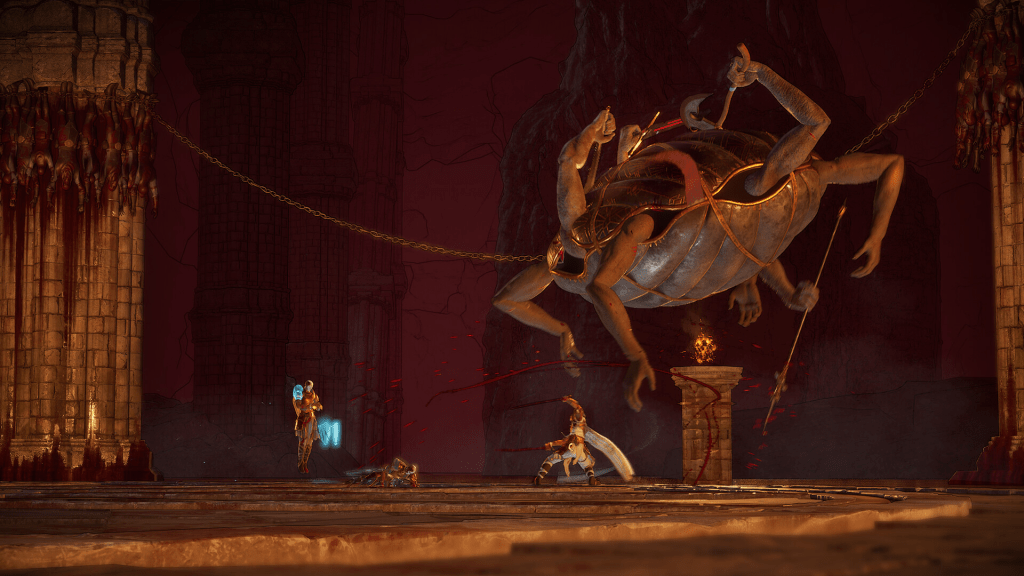
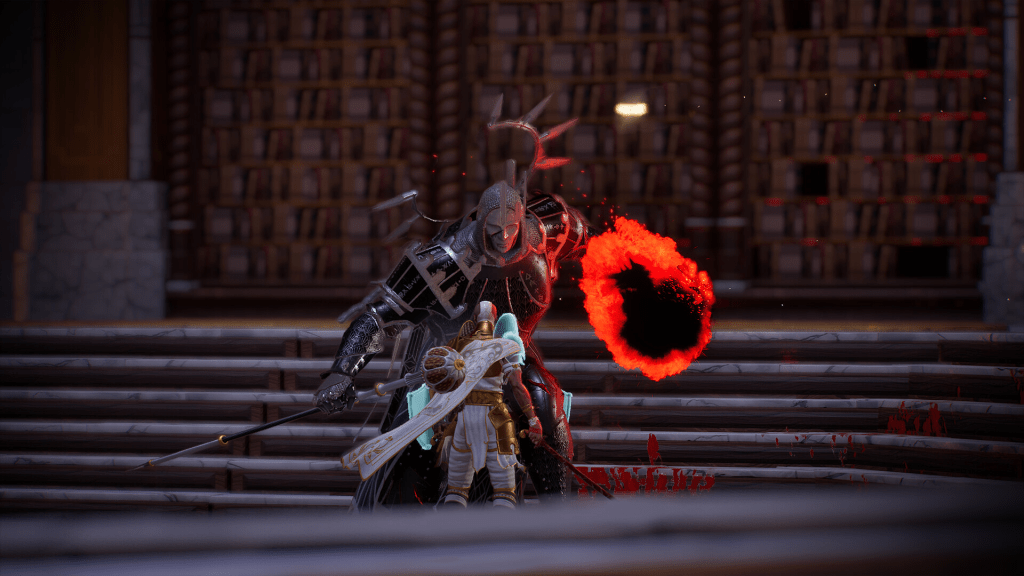
A core tension in Serpent’s Gaze is how it marries the meticulous, pattern-learning combat of a souls-like with the unpredictable run-variety of a roguelike. The studio made a bold, foundational choice: ditching procedural generation in favor of entirely handcrafted levels.
“Handcrafted levels are our anchor to the souls-like experience, as we want the players to learn the levels in order to find good approaches to different encounters,” the team explains, adding that it allows for much richer environmental storytelling. “We strongly feel that procedural levels have a tendency to become bland.”
So, how do they keep each run feeling fresh? The variance comes from dynamic enemy spawns, randomized upgrade selections, and a unique “Event Room” system. After defeating a boss, players enter a liminal space bridging the levels. “You might have a horde encounter, talk to strange creatures, or just appreciate a nice sculpture,” the team teases. These rooms offer unique upgrades that can’t be found anywhere else.
But the real wild card is the “Curse” system. Rather than relying on a lazy difficulty slider, the game introduces stacking modifiers that fundamentally alter the tactical landscape. Bestowed at the start of each level, these Curses interact synergistically.
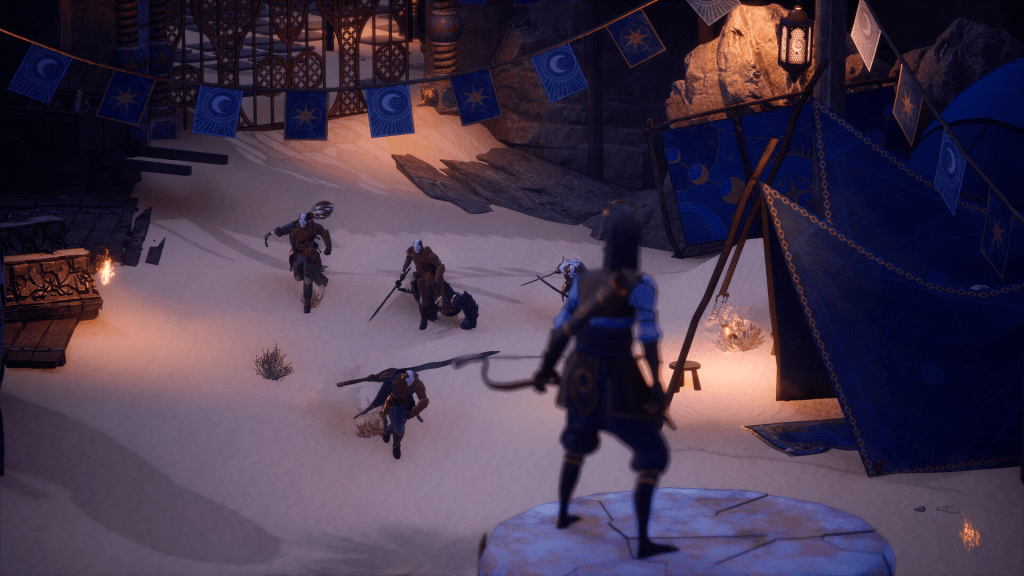
“One curse might spawn a guy who makes others invulnerable, while another curse adds enemies that summon minions if left undisturbed,” the developers illustrate. “Separately, they cause you to approach a situation differently, but together they just might make you cry a lonesome tear.”
The Nightmare of Four-Player Balancing
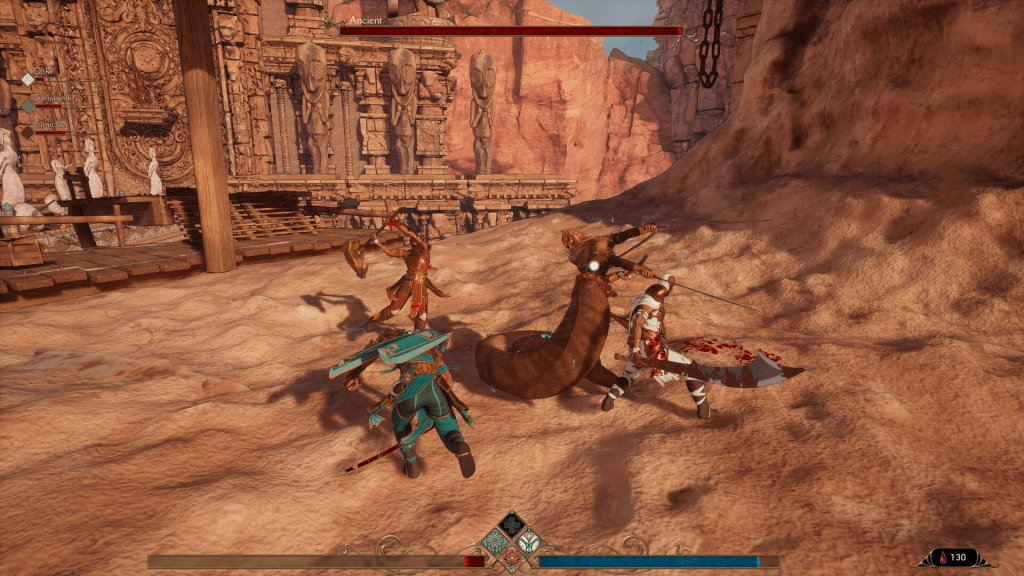
If there is one thing that keeps the team at Feeble Minds up at night, it’s balancing the game’s difficulty. Souls-likes are notoriously difficult to tune for a single player; making one work for up to four players simultaneously is a monumental task.
“Balancing co-op has definitely been the biggest challenge,” the team admits. “There is such a big leap in player power from one to four players, so keeping the vibe coherent becomes almost impossible. We did this to ourselves, however, because we’re not big fans of the latest trend of limiting co-op to three players.”
To solve this, they avoided the trap of simply inflating enemy health pools to match the player count, realizing early on that it turned the methodical souls-like combat into a mindless hack-and-slash. Instead, they opted for micro-adjustments across the board: slightly tweaking enemy stats, numbers, and aggression. They also designed enemy attacks with wide arcs, knowing that co-op players have a tendency to gang up on foes from behind.
Ultimately, they’ve accepted that the experience will naturally fracture based on party size. “The final approach has been to keep single and multiplayer slightly separated in ‘feeling’—it will always be more thrilling going on alone, vs the chaos of co-op.”
Doing Early Access Right
To prove their concept, Feeble Minds made the aggressive decision to drop a playable demo on the exact same day they revealed the studio to the world. Their reasoning is purely pragmatic: “A studio without a game is not that interesting, so why not give them a game demo immediately?” They are hoping the hands-on feedback will validate their direction and difficulty tuning.
They are well-equipped to handle that feedback, too. Studio Game Director Oscar brings a wealth of experience from Satisfactory, widely considered a gold standard for Early Access development. His philosophy is strict: “Early access has to actually be early access. You can’t have a finished game that is just polished during early access… you must divide the game up into chunks that you finish up in succession.”
He also cautions against taking player feedback too literally. When a player complains an enemy is “too tanky,” the actual issue might be that the enemy is too aggressive, depriving the player of damage windows and dragging the fight out. “It is really hard to take feedback, because you’ve spent years creating this game together,” Oscar admits. “So when you hear about problems with your baby it is easy to rush to fix it without thinking it through properly, losing direction and coherency.” He also warns against designing solely for “specialists”—hardcore players whose hyper-specific tastes can alienate the broader public.
As Feeble Minds steps out of the shadow of their massive previous hits and into the fiercely competitive indie space, they carry a clear-eyed vision and a healthy dose of independence. When asked for their single biggest piece of advice for other small teams trying to make their mark today, their answer is as uncompromising as the game they are building:
“Make the game you want to play yourself, not the game you think others will want to play—and avoid publishers at all costs.”


 Dev & Play Media
Leave a reply to Boban Cancel reply