
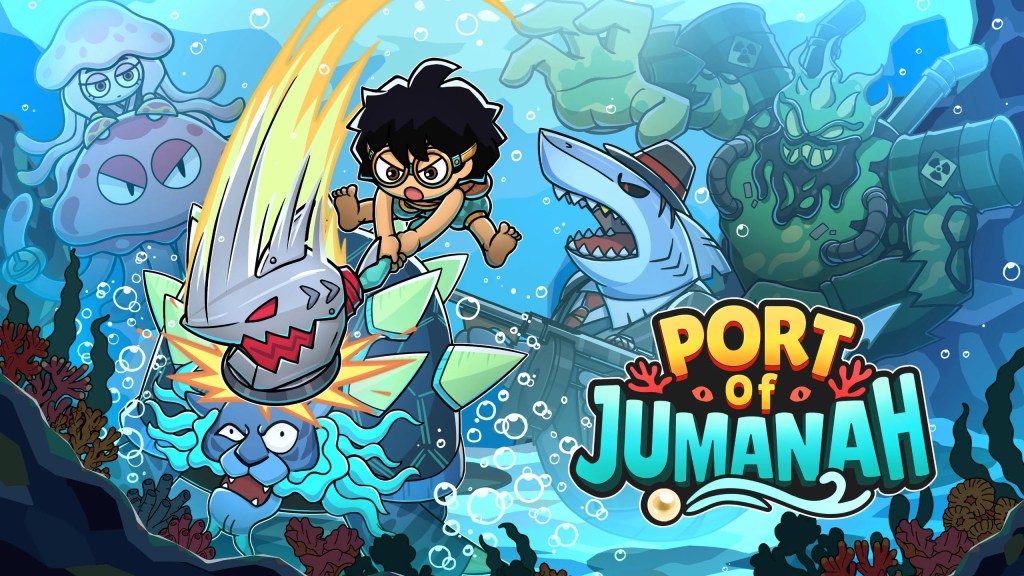
There is something immediately charming about Port of Jumanah. It is the kind of game that welcomes you with warm colours, cute characters and a soundtrack that makes even swimming around dangerous waters feel strangely relaxing. But, underneath all that cuteness hides quite the complex title that will put all your skills to the test.
In this adorable title, you swim and fight your way through a series of underwater expeditions, mixing melee attacks with a dash that quickly becomes one of your most important tools. The style and some of the more basic mechanics reminded us somewhat of the Cat Quest games, especially the chill vibes that come from exploring, fighting enemies and listening to the relaxing soundtrack. But that’s pretty much where the comparison ends.
There is no huge open world to wander around here. Instead, Port of Jumanah gives us a small town that acts as our hub between expeditions. But, there’s more. A lot more.
From the port to the depths
While on dry land, we can walk around the town, speak to its inhabitants and take care of quests before heading back to the dock. There is a store, a cafe and a lab to visit, and each has its own role in preparing us for another trip beneath the surface.
We also loved all the opportunities to meet new people and chat for a bit. It’s not all fighting here. Often you exchange a word or two and find out more about the world and all the strange creatures inhabiting it. Some of these characters aren’t simply there to provide dialogue either. Help certain NPCs with their problems and they can eventually join your expeditions, providing passive bonuses that can make a real difference.
This gives the little town a purpose beyond being a menu with buildings. You’re gradually rebuilding and developing your base while getting to know the people who live there, and then taking what you’ve earned back into the water.
Diving in
Port of Jumanah is a roguelite, so expeditions are split into smaller, arena-like areas. Once you’re done with one zone, you move on to the next, with the game often giving you a choice about what kind of challenge or reward you want to pursue.
Do you want the next map to focus on normal combat? Are you ready to take on a boss? Or would it be better to look for a reward, a power-up, a weapon or perhaps a vending machine?
These choices give the expeditions a nice sense of direction without making them feel overly complicated. You’re constantly weighing up what would be most useful for the current run. Clearing zones rewards you with coins, pearls and materials, which can then feed back into your progression and upgrades.
You will also meet some rather strange characters along the way who can help by granting you Shell Boosters. Despite the fancy name, these are essentially buffs that can improve things such as gadget damage or the strength of your melee attacks. Picking the right bonuses can make a run considerably easier, particularly when the game starts throwing more enemies and tougher encounters at you.
Swimming, swinging and trying not to drown
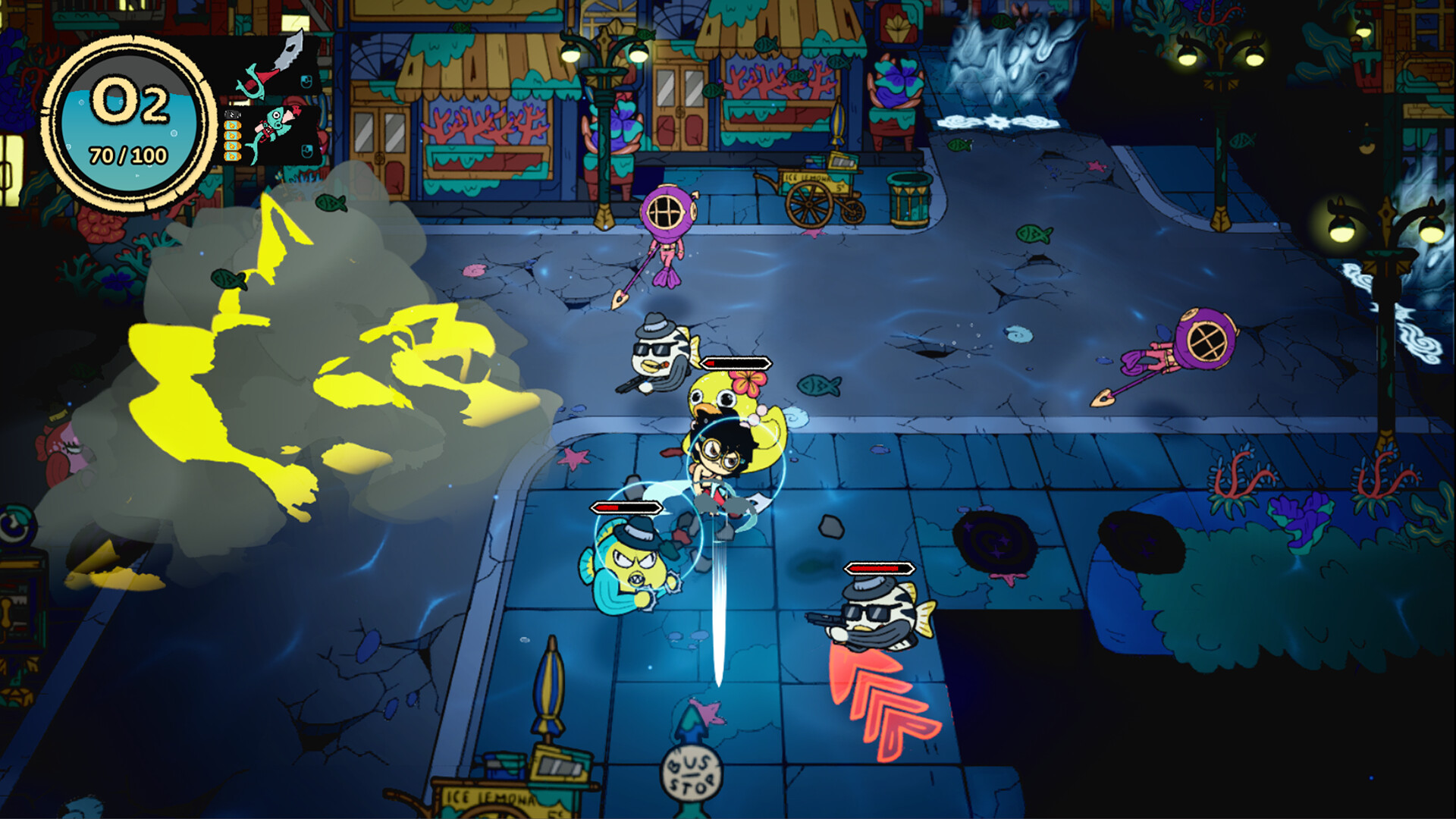
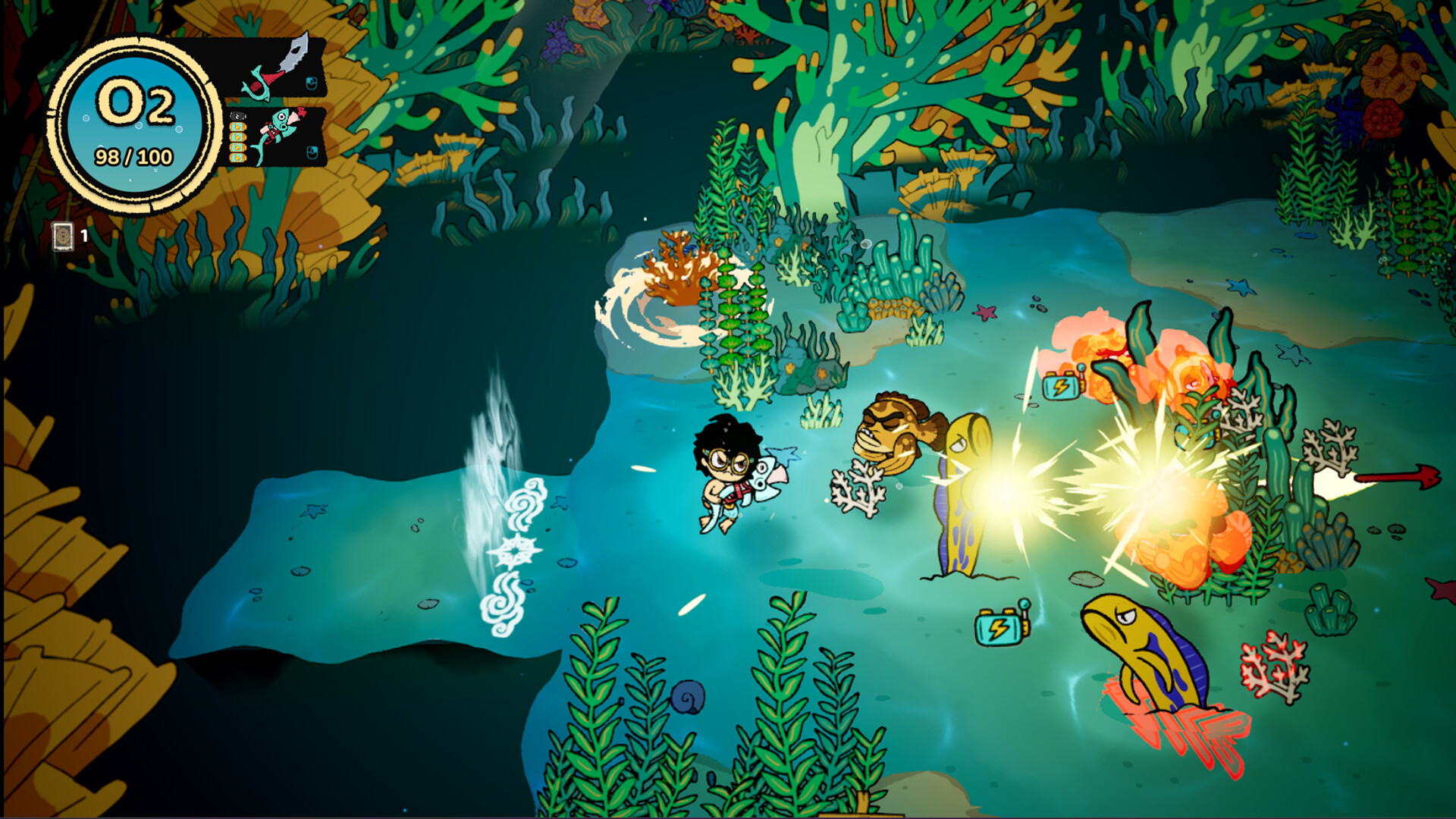
The combat itself is straightforward at first. You have your melee attacks, your dash and gadgets that work as alternative weapons. The latter add some much-needed variety, with things such as a harpoon gun giving you another way of dealing with enemies instead of constantly getting up close.
Button mashing will not get you very far, though.
As you progress and more enemies and bosses are introduced, you might find yourself using that dash button more often. Dodging attacks becomes increasingly important, particularly when several enemies are attacking at once or the environment itself starts working against you.
There are also hazards to worry about, including hidden traps and effects such as stuns. These little additions stop the combat from becoming a simple matter of swimming towards whatever is closest and hitting it repeatedly.
And then there is oxygen.
You are not a fish, after all.
Your oxygen gradually depletes while you’re underwater, and taking damage can make the situation worse. There are oxygen shells and tanks scattered around that allow you to replenish your supply. It is a simple mechanic, but it adds another thing to keep in mind during longer expeditions.
A cartoon beneath the waves
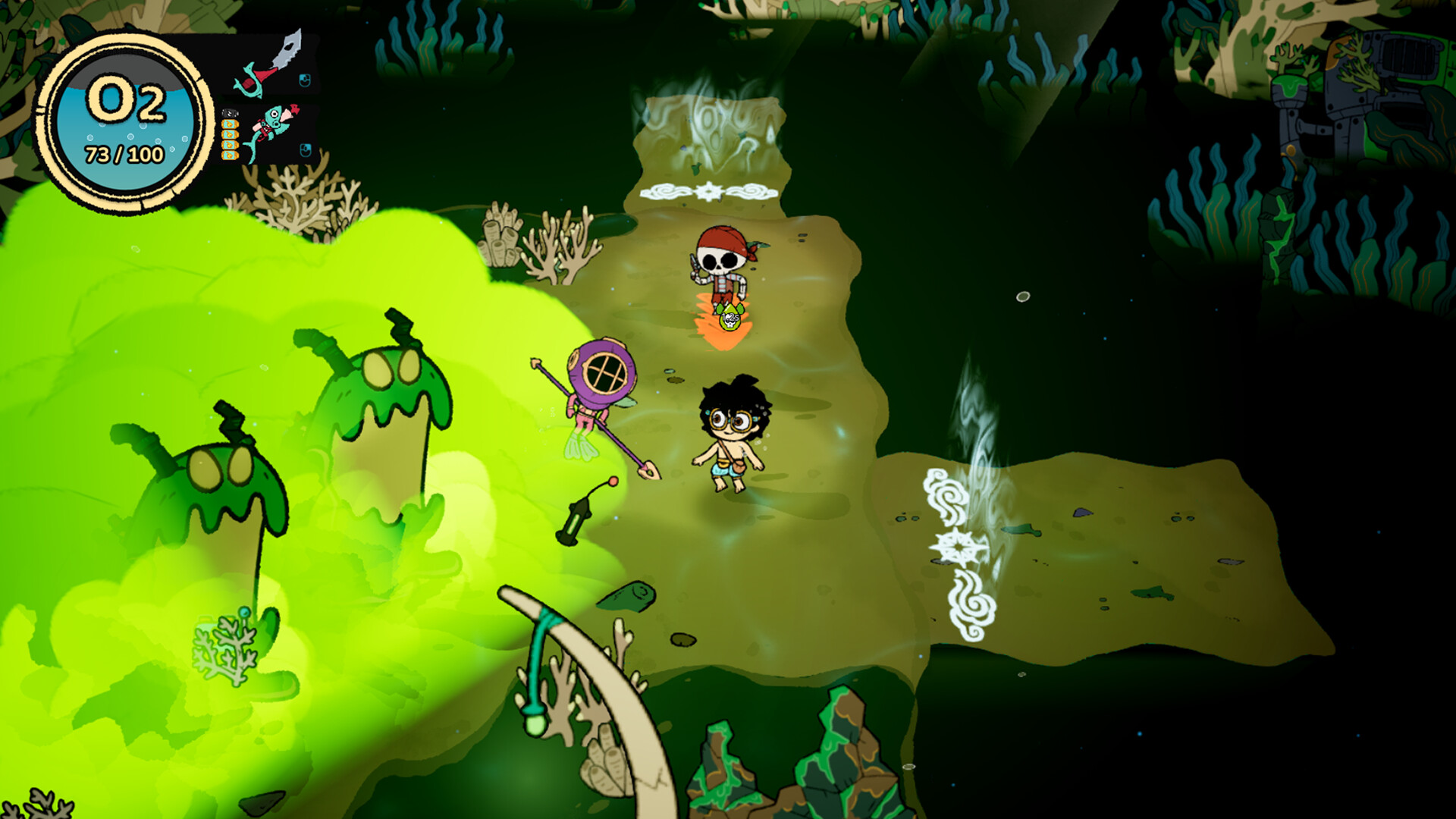
The enemies come in all shapes and forms, but they’re usually variations of sea animals that are cutely drawn and animated. It feels like you’re part of a cartoon rather than exploring some dark and dangerous ocean floor.
The environments are warm and filled with all kinds of flora and fauna, and the different regions offer their own enemies and treasures.
The soundtrack fits the relaxed side of the game particularly well and there is something amusing about calmly swimming through a colourful underwater environment while preparing to fight something that probably wants to turn you into lunch.
Building your crew
Before heading out from the dock, you’re also given the opportunity to decide what you’re taking with you. Weapons and crew members can be selected before an expedition, giving you another way to prepare for whatever lies ahead.
Different characters provide different passive benefits, so choosing who comes along can complement the way you want to play. A more combat-focused setup can help you deal with tougher encounters, while other bonuses may be more useful for a particular expedition.
And yes, there is also a cat.
We are not going to question why there is a cat involved in all of this. The game clearly isn’t interested in explaining every questionable decision it makes, which is perfectly fine by us.
A fun, little roguelite
On one hand, Port of Jumanah is a cute, colourful and fairly relaxed game where you can wander around town, talk to its inhabitants and listen to a pleasant soundtrack. On the other, the moment you dive into an expedition, the game starts asking you to pay attention to enemy attacks, oxygen levels, hazards, buffs and the route you’re taking through each area.
It never completely loses its laid-back personality, though. Even when things get hectic, there is a playful quality to everything happening around you.
The roguelite structure also works nicely with the idea of rebuilding your port. You go out, explore, fight, collect resources and hopefully come back with enough to improve your situation. Then you prepare for another dive, bring along different equipment or crew members and try again.
Port of Jumanah won’t be for anyone looking for a massive underwater open world or a hugely complex action RPG. But if you want to come back to it in short bursts, it’s a fun title that shouldn’t be overlooked.

Leave a comment