
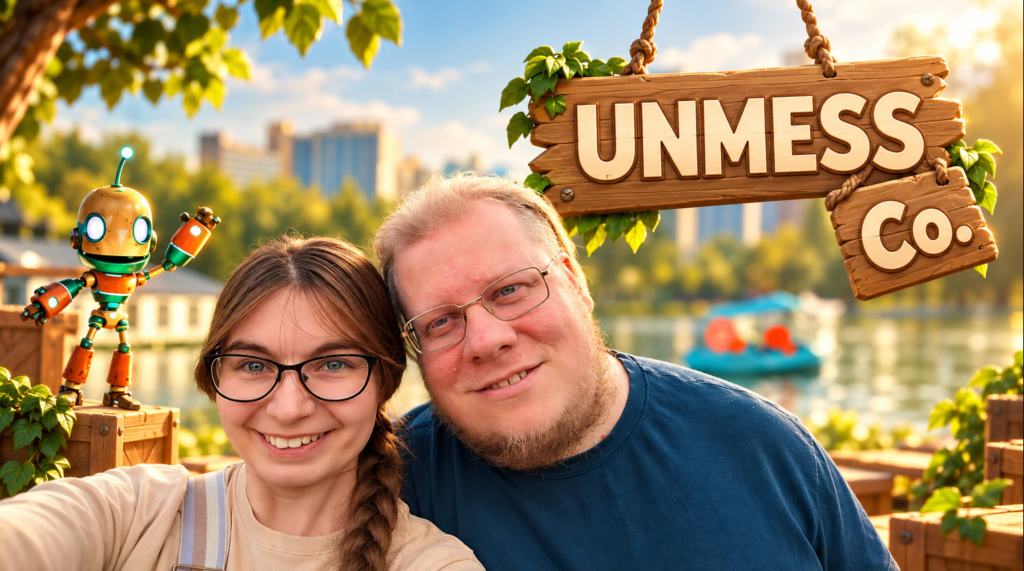
For Nikolay and Asya, a convincing disaster takes planning. In Unmess Co.: Rewind the Wreck, players find rooms full of broken objects and use a little robot to rewind the damage. What takes a few satisfying seconds on screen can involve a surprising amount of work behind the scenes. The planning became so detailed that the game’s designer joked about feeling like an accountant. We wouldn’t have expected quite so much paperwork from a game about putting things back in their place!
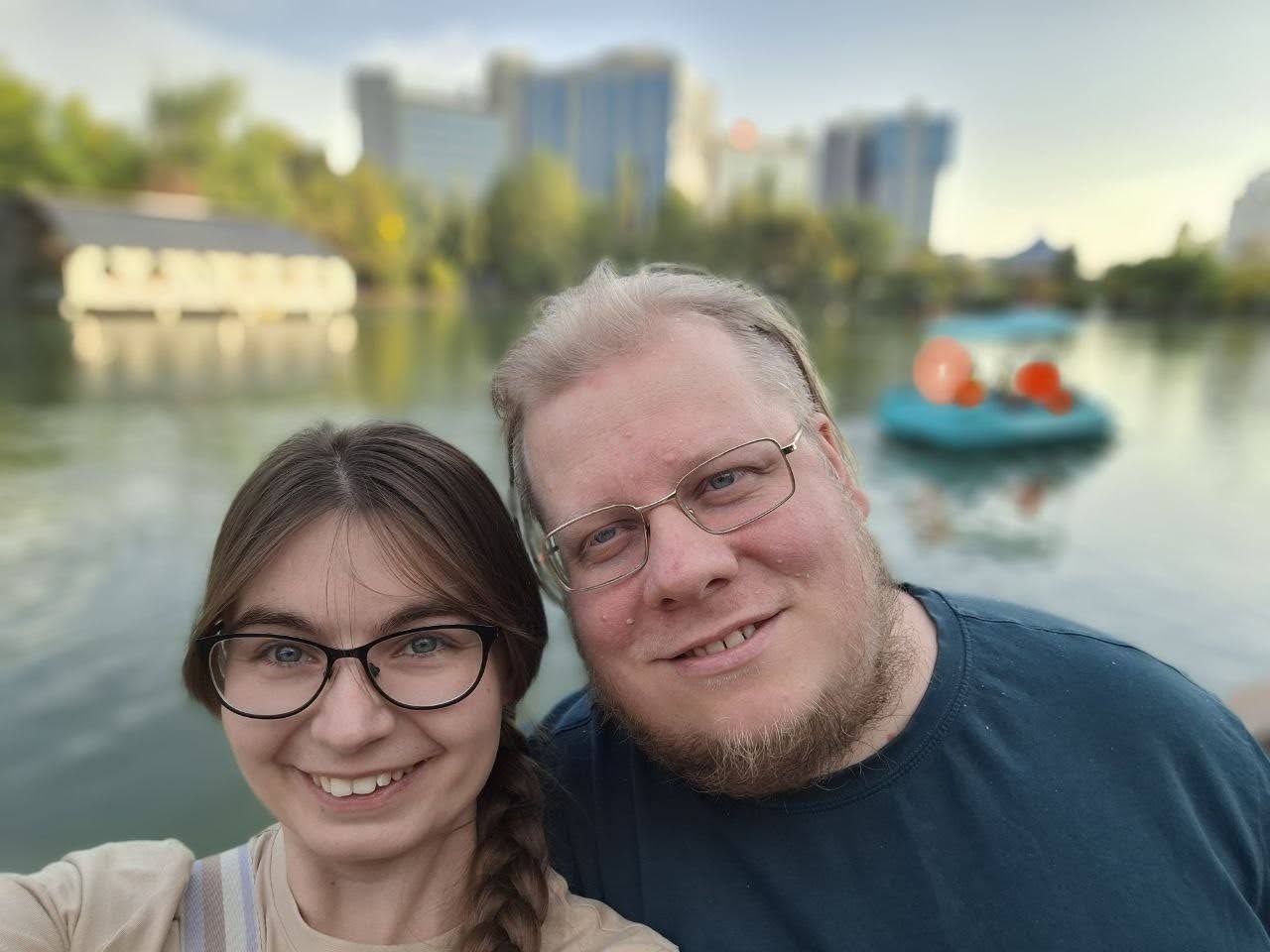
Nikolay and Asya are a husband-and-wife team making Unmess Co. together as Traveler Ant. We spoke with them about building the game’s puzzles, the workplace experiences that inspired its humour, and what they’ve learned from people playing the demo. Much of our conversation came back to the same challenge: making something carefully designed feel easy and enjoyable to play.
Building a Disaster
We were curious how the team could make every fragment return to its proper place without pieces overlapping or flying through the rest of the room. The answer turned out to involve far more manual work than we expected.
That question really gets to the heart of it. While we were still prototyping the first level, we realised that preparing the objects and their fragments would be one of the most difficult and time-consuming parts of building a room. There is a lot of hands-on work behind a restoration that takes just a few seconds on screen.
First, we choose and prepare the models so that they fit together visually and make the room feel natural and lived-in. Then we manually break each object into fragments, trying to make the damage look believable within the context of our game.
The next task is placing those fragments. The mess needs to look natural, but it also has to function as a puzzle: some objects prevent others from being restored, and we need to account for those relationships. The way the fragments move as they come back together matters too. We try to position them so that they do not pass through nearby objects or the robot, and so that the restoration itself looks appealing and convincing. Simply scattering debris around the room is not enough. We have to think through both the broken state and the process of making the object whole again.
We also pay particular attention to where the object comes back together. Watching scattered fragments reassemble into a single object should be satisfying. We choose the positions of the fragments and the point where they come together with the player’s view in mind, so they can see that moment clearly and appreciate the details.
Keeping all the information about a level in one document helped enormously. We recorded every object, its dimensions and the space it occupied, which objects blocked which, how each one reassembled, and other important details. At one point, our designer joked that she felt like an accountant, because the records had become so detailed. But for a small team, they proved genuinely useful. When each object has relationships with several others, keeping the whole picture in your head becomes difficult. For us, documentation became an important part of designing these puzzles, rather than just a formality.
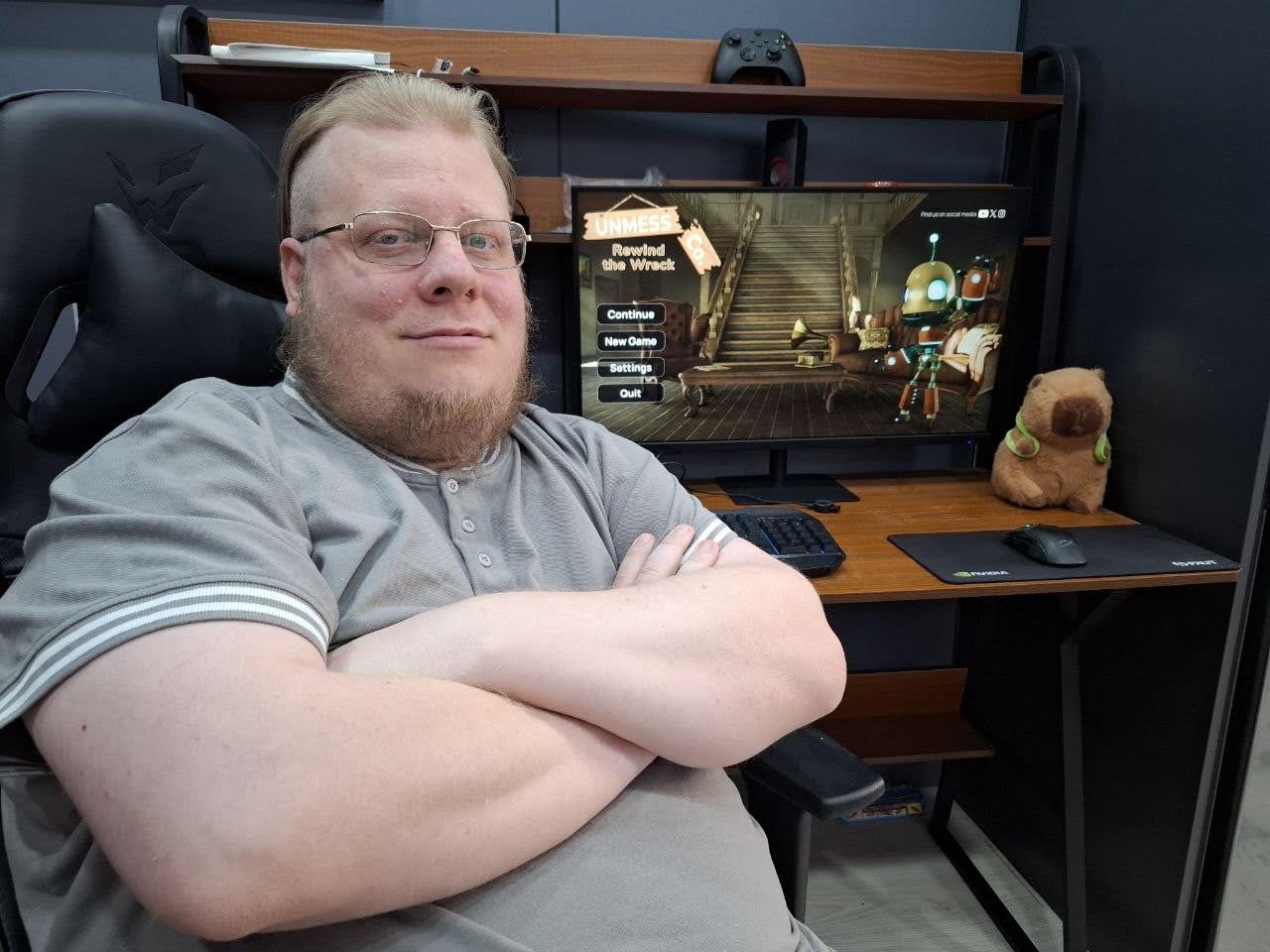
After all that preparation, Nikolay and Asya hand the problem over to the player. They know the right order to restore everything; we have to discover it from the wreckage. That makes the rewind more than a nice animation to watch.
We wanted restoration to feel relaxing and visually satisfying, while giving players small challenges that encourage them to pay attention and take an active part. That is why the order of restoration became part of the puzzle: you need to look around the room, work out which objects are blocking one another, and decide where to start. We want both the process itself and the moment of finding a solution to feel rewarding.
The mechanic also serves another purpose: encouraging players to wonder what happened here. We approach each level as a room with its own story and an incident that left it in disarray. By examining the arrangement of objects, the damage, and the smaller details, players can gradually piece together their own version of events. The game does not ask them to give the correct answer to that mystery, but we want careful observation to help them notice more and better understand the room’s story.
At the same time, we aim to keep the difficulty moderate. The puzzles should hold players’ interest and offer the satisfaction of small discoveries, while still leaving room to relax. We want players to be able to take their time, work things out, and enjoy the process.
After a busy day, it can be nice to do something simple and see the results straight away. In Unmess Co., a broken object becomes whole again and returns to its place. There is a little magic in that, and a simple sense of satisfaction: a moment ago, everything was in chaos, and now, thanks to you, order is gradually returning.
The Clues in an Untidy Room
A room in Unmess Co. is both a puzzle and the aftermath of an incident. There’s no correct theory we have to submit about what happened, but the scene should still leave us curious. The photograph of the undamaged room has to help without turning exploration into an exercise in copying an image.
When we work on a level, we keep a separate copy of the scene in its original state. It provides the basis for the photograph the player receives, and it also gives us a visual reference for what the room looked like before the incident.
Creating that photograph turned out to be quite time-consuming. Simply choosing an attractive angle is not enough. What matters more is that the image helps players make sense of the space: where the photograph was taken from, which objects are visible, and how they were arranged before. Comparing it with the damaged room can also offer a hint about what happened there.
We spend a lot of time choosing the angle and thinking about how much information it reveals. We want the photograph to help players find their bearings, not replace exploring the room itself. Players should still enjoy looking around, noticing details, and comparing what they see with the photograph.
This is especially important in rooms with more than one level. We like having distinct areas within a single room: from the lower floor, for example, you might be able to see part of the upper floor, but not everything on it. A single photograph does not show the whole room, either. So we consider both what will be in the frame and what will be left out. We deliberately keep some of those unseen areas simple, while others leave more room for players to observe and draw their own conclusions. We are also considering the possibility of multiple photographs for a level in the future, but that is not a final decision yet.
We also like the fact that the photograph does not have to explain the whole story of the incident. It shows what the room used to look like, while its current state gives players room to form their own theories. Alongside the satisfaction of solving the puzzle, we want them to enjoy coming up with their own version of events: what happened here, and why did everything end up this way?
A Company With a Very Important Job
All that careful organisation has a funny counterpart inside the game. We operate a robot for a restoration company that likes to sound terribly important while its employees deal with the mess. Nikolay and Asya’s ideas about corporate life come from something rather more personal than a collection of office jokes.
Corporate humour was intended to be one of the defining features of Unmess Co. from the very beginning. We are drawn to the contrast between how an organisation presents itself and how things actually work. The official line is that everything is professional, respectable, and under control. In practice, an ordinary employee is left to clean up the consequences of organisational chaos. They get the most unpleasant jobs, along with the responsibility for the outcome.
But a large, unwieldy company is not our only inspiration. Some of this humour grew out of personal experience working in a small organisation that tried very hard to seem bigger than it was. Everyone had known one another for years, yet conversations would sometimes take on an exaggeratedly formal tone, as though they were part of a giant corporation. There is something both funny and rather endearing about that.
That exaggerated sense of importance is what we wanted to bring into the game. Sometimes grand language gets in the way of a simple explanation of what needs doing, and formality makes the work harder rather than helping it along. At the same time, we did not want the satire to be mean-spirited. Organising work really is difficult, and we are more interested in showing a recognisable kind of absurdity than simply making fun of everyone involved.
The robot fits that idea well: it is a small cog in the system, but it still has a personality of its own. And yes, we see it not just as the player’s means of getting around, but also as a potential source of additional gameplay situations and comic mishaps. We are working on those ideas, but we do not want to share the details just yet. They are still being developed and tested, and they may change considerably. We do not want to promise players specific mechanics before we know what actually works in practice, and in what form.
When Players See Something Different
The caution about unfinished robot features fits a team that has already had some surprises from testing. With the October demo in players’ hands, Nikolay and Asya began hearing about problems that weren’t obvious from their side of the screen.
After releasing the demo, especially during Steam Next Fest, we saw just how differently developers and players can perceive the same things. There are two of us on the team, and we spend a great deal of time in the game. We get used to certain aspects of it and stop noticing that someone encountering them for the first time might find them awkward or unclear.
The controls are a good example. Several players mentioned that using E to restore objects felt unfamiliar, and that they would find a mouse button more comfortable. Rather than simply replacing one button with another, we decided to let players rebind the controls within the limits supported by the game. Some prefer the mouse, some are happy with E, and others would choose a different key. We plan to add this option in one of the next few updates.
A keybinding is relatively straightforward to change. The harder problem is deciding whether a player is stuck because a puzzle is interesting or because an important detail is too easy to miss. For a team that knows where every piece belongs, that can be a difficult distinction to make.
Feedback also prompted us to look more closely at how players notice the relationships between objects. We wanted players to use careful observation to work out the order in which to restore objects, but some connections turned out to be less obvious than we had expected. This was particularly noticeable with small objects, things in dark corners, or objects that had ended up far from their original positions, perhaps after rolling down the stairs. We already understand how everything fits together, but the player still has to work it out.
We are now looking for a balance that preserves the satisfaction of working out a solution without turning it into a tedious hunt for tiny objects. One approach we are trying is to place smaller objects relatively close to where they need to return. We are also considering putting them into more noticeable groups, rather than scattering them individually. That is the approach we are leaning towards, but we are still working through the details.
That is why feedback matters so much to us. We consider players’ suggestions and comments, weigh them against the kind of game we want to make, and are already working on changes. An outside perspective helps us distinguish an engaging challenge from an inconvenience we have simply grown used to.
Making a tiny object easier to find is one kind of change. Deciding how difficult the whole game should be is another. The demo has made Nikolay and Asya revisit a choice they thought they’d already settled.
For us, it was less a single mechanic than the original idea of making the game much more challenging. Early on, we considered a version in which players would have to follow more complex chains of reasoning, with puzzles becoming the game’s main focus. Gradually, though, we realised that this was not quite the experience we wanted to offer.
We wanted players to be able to come to the game after work, unwind, watch objects being restored, and solve a few interesting puzzles along the way. So we dropped a number of complex mechanics and revisited the balance more than once. The question for us was not how difficult a puzzle we could devise, but whether it belonged in the game we were making.
At the same time, the demo showed us that some players wanted more challenging, less linear puzzles. We are currently preparing a harder version of our second level, “Life Star”, and considering different difficulty options that would change not just the level of challenge, but the structure of the puzzles themselves. However, the game is still in development, and that concept may change. For now, we do not want to promise multiple difficulty options for every level or say when they might become available.
Our advice to other developers would be to test a prototype as early as possible with people who are not involved in making the game and are not yet familiar with it. It is important to see not just whether the mechanics work, but also what first impression the game makes. Does the player understand what to do? Are they interested in figuring things out? How does playing make them feel? Do they want to keep going and see the next level? The longer you work on a project, the harder it becomes to answer those questions on your own.
Another important lesson for us has been to match the scope of the game to the time and resources we have. It is easy, especially in a small team, to get carried away with the number of ideas and the amount of content. But it is better to make less and give more attention to quality, engaging puzzles, and polish. Two carefully crafted levels can give players much more enjoyment than five made in a hurry. We want them to come away feeling good about the experience and curious about what comes next, rather than simply feeling that there was a lot of content.
Players won’t see the documents, abandoned ideas and hours of preparation behind each room. We’ll be far too busy enjoying the rewind. We’d like to thank Nikolay and Asya for sharing their experiences with us, and we wish them both the best of luck with Unmess Co.
Unmess Co.: Rewind the Wreck is in development for PC, with a free demo on Steam. The full game is currently listed for Q4 2026.


Leave a Reply