
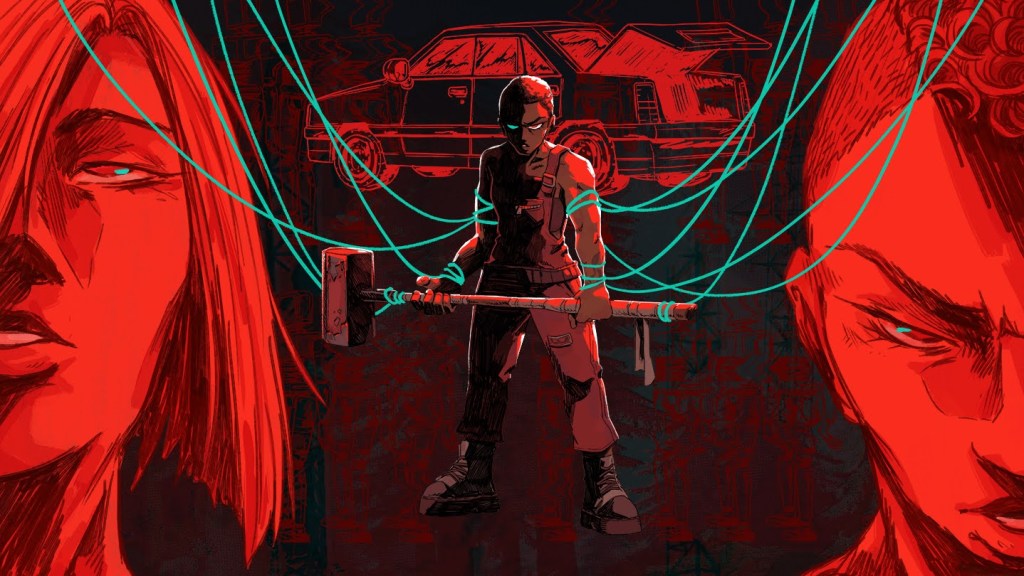
Virtue and a Sledgehammer is one of the best indie games we’ve played over the past two months. It managed to impress us not only with its carefully thought-out narrative but also with its outstanding art direction and clever gameplay mechanics. Developers Deconstructeam and Selkie Harbour have managed to capture poetry in motion, telling a disturbing story that, beneath all the flying bricks, hides a rather unpleasant family reunion. Like an onion, we peel back the narrative layer by layer, gradually uncovering a heartbreaking story about loss. Only, we don’t peel this onion with a knife. Our weapon of choice is a twenty-pound sledgehammer.
Platform: PC (Steam) | Developers: Deconstructeam, Selkie Harbour | Publisher: Devolver Digital | Playtime: 3–4 hours | Mode: Single-player
There’s No Place Like Home
We follow Pratelle, who arrives in her old mountain town after crashing her car. Her dead mother is in the trunk, and her sister Nina is somewhere ahead. Nina has been busy digitizing the town’s residents, recreating them as boxy white androids that carry their memories. Understandably, Pratelle isn’t particularly thrilled about any of this, and she decides to work through her anger one demolished wall at a time.
The game is played from a third-person perspective. We move through a series of areas, searching for a way forward and smashing the buildings that get in our way. Rather than looking for a door, we can make one with the hammer. Walls crumble under repeated blows, and damaging enough of a structure can send larger sections collapsing around us. Not everything is destructible, though. Trees and rocks define the boundaries, while houses and other man-made structures are fair game. It’s weirdly therapeutic. You know those places where you pay to enter a room, break dishes, and vent your anger? This is that, just cheaper. And a lot more satisfying.

There are three hammer attacks, controlled by how long we hold the button. A quick tap produces a shove that pushes nearby robots away. Hold a little longer and Pratelle swings the hammer sideways; charge it fully and she brings it down in a heavy overhead strike. The latter is especially useful for tougher enemies and stubborn structures. Each swing takes time to prepare and recover from, and our angry girl can’t sprint or dodge. Fighting several aggressive androids can therefore get cumbersome, although defeat carries little penalty. This isn’t a game that expects us to learn elaborate combos. No, no. This is a game that lets you bring down the hammer of destruction. And enjoy doing it.

Taking damage turns the screen red and black, but health regenerates once we’re out of danger. Even getting overwhelmed doesn’t carry a serious punishment, so there’s little reason to worry about losing progress. The hammer never becomes a particularly sophisticated weapon, but it doesn’t need to. We’re here to demolish a town, not master an elaborate combat system.
Breaking Things, Remembering People
Exploration also reveals fragments of Pratelle’s past. Smashing red fragments gives us brief glimpses of memories; collecting ten transports us to a separate space where we can enter a longer scene. Blue fragments can lead directly into memories, while some story sequences happen automatically.
Once we’ve collected ten red fragments, we can choose which longer memory to experience by smashing one of the objects in a strange, separate room. Some scenes also let us decide how Pratelle responds, and these choices can influence how her story unfolds. We won’t spoil the ending, but there’s more player involvement than watching flashbacks.
These interactive-fiction scenes uncover her complicated relationships with Nina and their mother, occasionally allowing us to choose how Pratelle responds. They’re important to the story, but many can be missed if we rush through town. Please don’t rush through. That would be the worst thing you could do. This is a game that needs to be slowly consumed. The destination is nothing; the journey is everything.

Aside from exploration and narrative exposition that usually hits us fast and hard, there are androids that we hit slowly but equally hard. Some attack on sight, but others beg us to stop or simply carry on with their routines. We can encounter residents taking refuge in a church or having tea in a café, and we’re free to leave many of them alone. We never do. We realize it’s an uncomfortable detail to share, but we’ve been given a very large hammer and the freedom to use it. That hammer was our therapist. And it whispered the sweetest nothings.

The angular, almost PS2-era characters and harsh flashes of red suit the increasingly unsettling atmosphere, helped along by eerie electronic music. It looks and sounds otherworldly, and we did our best to explore every nook and cranny, taking in as much of it as possible. The slow movement and repeated hammer swings may wear thin, particularly toward the end, but we didn’t mind that at all. We came for the spectacle, and we found plenty of that here. The memory scenes are what made us to keep looking behind the next wall.
Although we’re following a largely linear story, the areas are just long enough that we can roam and explore, with alternate routes occasionally leading to the same destination. There aren’t any conventional map markers telling us exactly where to go, but flashing red lights, wires and even strategically placed flowers help point us in the right direction.
Hammer Away!
Virtue and a Sledgehammer is best approached as a short, emotionally heavy story with demolition attached. Please don’t come here looking for demanding combat, as that’s so not the point. The point is to offer a therapeutic refuge where we can smash our frustrations away, only to gradually discover that the very thing we’re trying to escape is waiting for us beneath all that rubble. We came armed with a sledgehammer, convinced that breaking things would make us feel better. And for a while, it certainly did. Unfortunately, some things can’t be fixed with a hammer, no matter how hard we swing it.


Leave a Reply